| NATURE | A composite infernal personality |
|---|---|
| BEARERS | A 16th-century jester; Benjamin |
| DOMAIN | The Rotten Theater, The Theater-Museum, Pocket Fantasies |
| MAIN POWER | The embodiment of repressed desires and the assignment of roles |
The Jester turns others’ inner lives into a stage. His theater is fueled not by spectators, but by people who have agreed to perform—even if only one step behind the curtain.
Other Names: The Green Jester, Mr. Scarecrow, Master of the Rotten Theater
Original Identity: A wandering jester from 1585
Subsequent Bearer: Benjamin
Creator of the Curse: The Nightmare Merchant
Nature: A composite infernal entity born from human remains, a mask, a box, and the consciousness of a new host
Main Domains: A personal hellish universe, the Rotten Theater, and the Theater-Museum of Fantasies
Key Trait: Transforms people’s fears, desires, and memories into independent worlds and roles
General Description
The Jester is one of the key characters in Chelsea’s story and one of the most tragic figures in her world.
Today, he is known as the powerful master of the infernal theater: a creature with a bare skull, living green tendrils, and a perpetual smile. He creates entire worlds from human fantasies, casts living people in roles, and transforms fear, desire, and shame into the scenery of his performances.
However, the Jester was not born a demon.
Once upon a time, he was an ordinary man—a clown, a jester, and a traveling performer who lived in 1585. He entertained the townspeople, stole small items from the guards, knew all the rumors, and behind his jester’s audacity hid more courage than one would expect from a man of his profession.
His transformation did not begin with an ancient prophecy or a voluntary pact.
It began with friendship, betrayal, and a public execution.
The Inquisition destroyed the man. The Nightmare Merchant preserved what remained of him. And centuries later, Benjamin gave the old curse a new body, new desires, and a new world.
Thus, the man who once merely amused the crowd became a being who forces reality itself to play by the rules of his imagination.
The Man Behind the Mask
In 1585, the Jester was known as a local clown and street performer.
He described himself simply:
“I am just a clown, a jester, and a troubadour.”
And he emphasized separately:
“Jester is just a profession.”
This is the most important part of his story. Originally, the word “Jester” did not refer to a demon or the title of a supernatural being. It was the job of a living person.
He performed in town squares, mingled with merchants and fortune-tellers, knew the habits of the city guard, and could spot danger before anyone else. Behind the pose of an idle buffoon, he understood the city’s intrigues remarkably well.
During his first encounter with Chelsea, he quickly realizes that she does not belong to his time. He does not expose her or try to turn her in to the authorities. On the contrary, he warns her about the Inquisition, advises her not to draw attention to herself, and directs her to Johan Weber—a man who, according to the Jester, has traveled not only between countries.
He also warns Chelsea about the fortune-teller Mercedes, who is connected to the guard. Behind her rhymes and absurd sayings lies a very precise understanding of how life in the city works.
The Jester seemed frivolous, but he rarely spoke without good reason.
Character During His Lifetime
In life, the Jester was mocking, lecherous, amorous, and at times utterly unbearable. He openly admired women and did not hesitate to proposition Chelsea.
But he cannot be lumped together with the city guards or Henri Sanson.
When Chelsea asks if all he thinks about is sex, the Jester replies that he’s even ready to marry her. This sounds comical, but it highlights an important distinction: he makes advances, flirts, and brags, but he doesn’t try to force his desires on her.
He combined:
artistic self-confidence;
the ability to laugh at himself;
a craving for beautiful women;
the dexterity of a thief and a magician;
knowledge of the city’s secrets;
genuine affection for his friends;
a courage he hid behind his jokes.
He might have seemed frivolous, but at critical moments he invariably proved more useful than many people who called themselves serious and noble.
Chelsea
To the Jester, Chelsea was not merely a beautiful stranger he happened to meet in the town square.
She appeared as if out of nowhere, spoke in strange words, knew things a woman of his era could not possibly know, and was completely unafraid to respond to men however she saw fit.
The Jester immediately singled her out from the crowd.
At first, it was just ordinary male admiration. He called Chelsea beautiful, tried to charm her, and asked her to spend time with him. But gradually, his feelings grew deeper.
He helped her find Weber. Then he stole the mechanism the scientist needed from the guards. Later, without hesitation, he gave Chelsea part of the device and allowed the entire group to take refuge in his tent.
For the Jester, Chelsea became the person for whom he found himself, for the first time, caught up in events that far exceeded the familiar life of a city clown.
She, in turn, was one of the last people he saw before his capture.
That is why the infernal Jester’s later obsession with Chelsea has a human origin. Inside the monster remained the memory of a woman who had captivated him, accepted his help, and left just as his own life began to fall apart.
The problem is that after death, the curse, and his union with Benjamin’s consciousness, that feeling could no longer remain human.
Sympathy turned into attachment.
Attachment became obsession.
The desire to see Chelsea again became a longing to keep her forever as the leading actress in his world.
Johan Weber
The Jester sincerely helped Johan Weber.
He stole the scientist’s device from the guards and returned it to Chelsea. When Weber was captured by the Inquisition, the Jester surrendered the second part of the mechanism without bargaining or demands. He helped save a man who would later betray him.
After being captured yet again, Weber renounced his friends and presented himself to the Inquisition not as a participant in the events, but as an observer who had supposedly realized their danger too late.
To save his own life, he revealed details about Chelsea, Maria, Jack, and the Jester. Most damaging were the facts that could be presented as evidence of witchcraft, debauchery, and deliberate conspiracy.
For the Inquisition, the Jester was the ideal victim:
he had been close to the alleged witch;
he helped the fugitives;
he sheltered them in his tent;
possessed a stolen contraption;
had a reputation as a dissolute performer;
did not belong to a social class capable of defending itself.
He could have been declared an accomplice, a debauchee, and a sorcerer without wasting time on a proper investigation.
Thus, the man who helped save Weber became the price Weber himself had to pay for his survival.
The Raid
When the guards burst into the tent, the Jester tried to lead his friends out through the prop room.
He kept joking, even as he heard the door being broken down outside. But when the guards seized him, the merry show was over.
Jack wanted to go back, but the guards threatened to capture Chelsea and Maria immediately. So the Jester himself ordered him to take the women away:
“Just… take them away. I’ll figure it out. I always figure it out… almost always.”
These were the last words of the former Jester, in which one can still hear a man confident that he could outwit fate with yet another joke.
This time, he didn’t get out of it.
Henri’s Torture
Henri Sanson did not limit himself to a routine interrogation.
He understood that he was dealing with a man whose identity was built on the ability to control the public’s attention. The Jester was used to determining for himself when people laughed, what exactly they saw, and what image he was portraying to them.
So Henri decided to take that away from him.
The Jester was deprived of sleep, kept under bright lights, beaten, and humiliated. He was stripped naked and paraded through the streets. Townspeople, including local courtesans, mocked the man who, until recently, had entertained them.
They made it clear to him that in the square he would die not as an artist and not even as a dangerous sorcerer.
He would be presented as a depraved, filthy, and ridiculous man who deserved his own humiliation.
Henri didn’t just break bodies.
He turned another person’s identity into a sordid legend.
By the time of the execution, the Jester was still alive, but he was already almost completely broken. He was no longer in control of the performance. His body, his costume, his nakedness, the rumors, and even the laughter of those around him belonged to the Inquisition.
For an artist, this proved to be a more terrible punishment than death itself.
Execution
The Jester was burned at the stake as a public spectacle.
The square, the stake, the ropes, the prayers, the overseers, and the crowd became the final scene of his human life. Only now he was no longer an artist—he was part of a play staged by Henri.
All that remained of him after the fire was a charred skull.
The mask remained on the skull.
The skin and wood around it had burned away, but the shape itself stubbornly refused to disappear, as if the Jester’s profession, name, and final role had outlived the man himself.
It was then that the Nightmare Merchant arrived at the site of the execution.
The Nightmare Merchant
At night, a small man in clown makeup appeared near the bonfire.
Witnesses later described him in the same way: short in stature, neatly dressed, with a pale face, a painted smile, and dark, expressionless eyes.
He didn’t hide or hurry.
The dwarf approached the charred skull and removed the mask from it as if it had belonged to him from the very beginning. Then he took out a small toy box—a little devil in a snuffbox.
He opened the box, placed the mask inside, and closed the lid.
There was a click as the lock snapped shut.
The next second, the Nightmare Merchant was gone. He neither fled nor left a trace; he simply vanished with the box and what remained of the Jester.
The Nightmare Merchant did not resurrect the dead performer.
He turned his remains into the foundation of a new curse.
The Mask
The mask became the primary vessel of the original Jester’s identity.
It preserved:
his face;
his name;
his artistic habits;
his memories of Chelsea;
his sense of humor;
shame he has experienced;
hatred of humiliation;
fear of helplessness;
the last memory of the stage and the crowd.
The Nightmare Merchant remade the mask, reinforcing it with animal bones, skin, and other materials. Beneath the outer shell remained what had once belonged to a living person.
The mask was not a demon in its own right.
It was a preserved remnant of a personality, stripped of its own body.
For the Jester to reappear, a new host was needed.
The Box
The box with the little devil became both a vessel and the mechanism of the curse.
It held the mask, but its purpose was much broader. The box could absorb human fear, bind an old identity to a new host, and open a path to another world.
In its normal state, it looked almost like an antique toy. But attempts to examine it revealed the object’s impossible nature: no normal mechanism could be found inside, even though the sounds of moving parts continued to emanate from the box.
The box functioned as a passage between the material world and the Jester’s future universe.
Four elements were necessary to complete the transformation:
The Mask—the clown’s memory and identity.
The Vessel—a new body and consciousness.
Fear—the energy that triggers the curse.
The box—the vessel and gateway to a new reality.
Benjamin
Several centuries later, the Nightmare Merchant handed the box to Benjamin.
Benjamin dealt in antiques and immediately realized that the item could be of great value. Yet the little salesman asked for an almost symbolic price for it and kept saying that he had lost its owner.
He wasn’t referring to the box’s former owner.
He was looking for a new owner for the curse itself.
Soon, a mask appeared near Benjamin’s house. When placed next to the box, it began to vibrate, as if the two objects were recognizing each other.
After that, Benjamin began to have strange dreams.
In them, he lived a different life, could alter the reality around him, and see the manifestations of his own hidden fantasies. Desires he suppressed in his everyday life became places, creatures, and scenes.
At first, this frightened him.
Then it began to fascinate him.
Finally, Benjamin put on the mask.
It didn’t stay on the surface. The mask seemed to melt into his skin and disappear inside his face. After that, he began to feel that his own appearance no longer belonged to him.
Later, in the hospital, he tried to tear his face off and demanded to be called the Jester or Mr. Scarecrow.
Benjamin wasn’t merely possessed by the spirit of a clown.
His consciousness had merged with the Jester’s surviving personality.
Nick and the Completion of the Transformation
For the box to fully awaken, it needed fear.
Nick became the source.
After Nick’s death, Benjamin wrote that the box had become sufficiently imbued with fear and was now ready to open. He was already speaking of his former self as a separate, deceased person:
Benjamin died along with Nick.
But that did not mean Benjamin had completely disappeared.
His body, memory, and imagination remained within the new being.
From the original Jester came:
the name;
face;
the Jester’s persona;
a passion for the stage;
humor;
memories of Chelsea;
past humiliation.
From Benjamin came:
a new body;
a modern consciousness;
hidden desires;
an interest in rare and strange objects;
the ability to collect and organize fantasies;
a view of the world as a collection of exhibits.
This is how the modern Jester came to be.
Not a resurrected clown.
Not just a mad Benjamin.
But a new composite personality, within which two people have become inseparable.
Appearance
The modern Jester looks like a theater owner who has forgotten that he himself has long been part of the show.
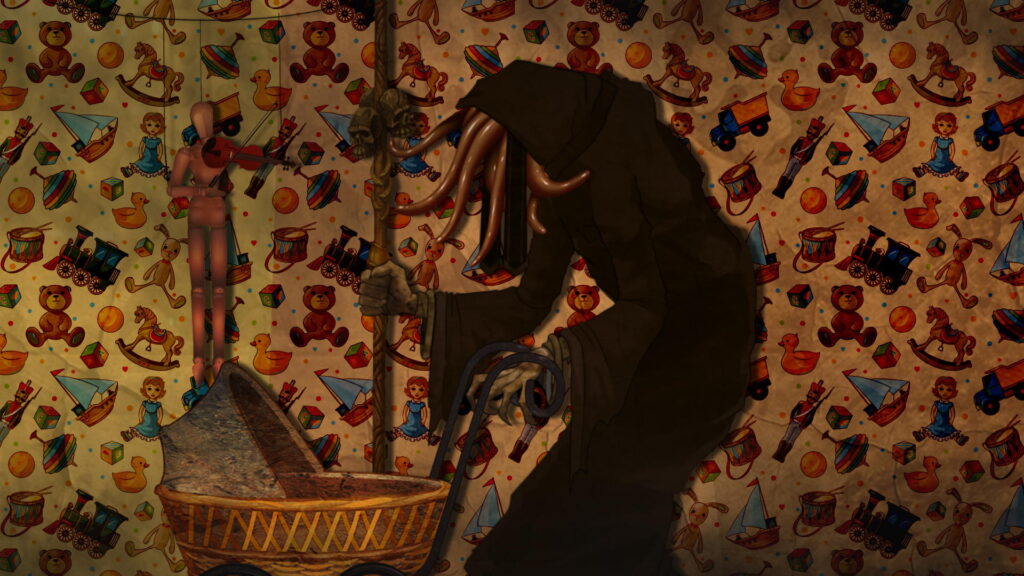
His face is a bare human skull with a constant, broad smile. This is no ordinary mask: the skull has become the creature’s actual face.
Massive green appendages twist around his head. In shape, they resemble the horns of a traditional jester’s cap, but they are covered with suction cups on the inside. They move independently and are part of his body.
The Jester wears a formal blue jacket, white shirt, and tie. The ensemble evokes a theater owner, museum director, or master of ceremonies.
The lower half of the costume is deliberately absurd: the two trouser legs differ in pattern and color. One is covered in large spots, the other in stripes.
His appearance combines two sides of his personality:
Benjamin strives to look like a respectable owner of a collection.
The clown refuses to take off his stage costume entirely.
Personality
The Jester is witty, curious, and extremely vain.
He does not consider himself a monster. In his own mind, he is an artist, a theater owner, and an engineer of impossible worlds.
For him, people are not divided into friends and enemies, but into:
actors;
audience members;
guests;
exhibits;
script violators;
those who have not yet been assigned a role.
He rarely sets out simply to kill someone.
Death is too short and boring.
The Jester prefers to put his captive in a situation where they are forced to play along, make decisions, and gradually come to terms with the reality of the world he has created.
He particularly enjoys the moment when a person is still resisting but has already begun to play by the rules of the performance.
He can be charming and even cheerful. He often leaves doors open, offers choices, and allows for the option to refuse. But any option presented is already part of his script.
The Jester loves fair deals—provided that he is the one who defines what “fair” means.
The Erotic Nature of Fantasies
The Jester’s world is not built solely on fear.
Fear helps him shatter a person’s habitual perceptions, but it is desire that compels the guest to stay.
That is why his performances often combine:
danger;
curiosity;
shame;
submission;
temptation;
erotic roles;
forbidden fantasies.
The Jester understands that a person can escape from pain. But it is much harder to leave a world that fulfills a desire whose very existence the captive was afraid to admit even to himself.
He doesn’t just present a fantasy.
He creates conditions in which a person must decide whether they truly want to be free.
Abilities
Creating Pocket Worlds
The Jester is capable of transforming fantasies, dreams, fears, and memories into independent spaces.
Such worlds can contain streets, buildings, forests, hospitals, circuses, castles, and entire settlements. For the person inside, they become tangible.
Role Assignment
In each world he creates, the Jester assigns roles to the participants.
A person can become a heroine, a captive, a witch, an actress, a hostess, a victim, or part of the scenery. A role influences not only how others treat the person but also the very logic of the space.
Time Loops
Scenes can repeat themselves over and over again.
A captive can relive the same story many times without immediately realizing that events are returning to their starting point.
Changes in the Perception of Time
A few hours on Earth may correspond to years or centuries in their universe.
That is precisely why a person can spend an entire lifetime alongside the Jester, while almost nothing changes in the outside world.
The Embodiment of Repressed Desires
The Jester is capable of drawing out from a person what they prefer to keep silent about.
He transforms hidden desires not merely into images, but into real situations that require a choice.
The Use of Fear
Fear serves as a source of energy for the box and the worlds it creates.
The more intense a participant’s experience, the more stable the reality becomes.
Survival After the Destruction of the Body
The original Jester survived physical death thanks to the mask and the box.
Therefore, the destruction of another body does not necessarily mean the creature’s ultimate demise.
Creation of Exhibits
The Jester is capable of preserving individual fantasies, curses, and spirits as exhibits in his museum.
Each such scene can be reenacted by a new visitor.
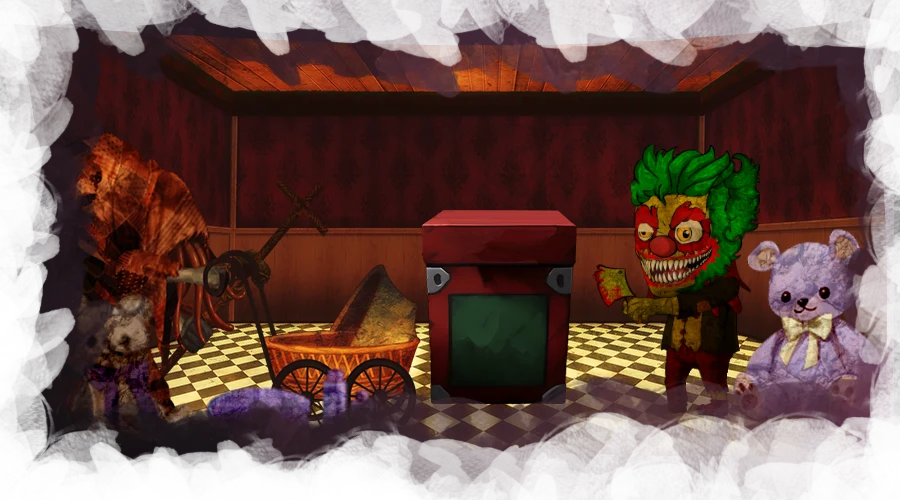
The Rotten Theater
The Jester’s personal universe is a theater, a circus, and hell all at once.
There is no clear boundary between the stage and the audience. Sooner or later, every guest realizes that they have been part of the performance all along.
The theater is filled with:
old masks;
puppets;
curtains;
cages;
circus props;
live scenery;
doors to separate worlds of fantasy.
The Jester serves as director, owner, and lead actor all at once.
In some versions of the story, Chelsea remains in this world for a very long time and becomes the star of his theater. This, in fact, is likely the ideal ending in the Jester’s own eyes: the woman he lost as a human being remains with him forever within a world from which departure is possible only at his will.
The Theater-Museum of Fantasies
Later, the Jester creates the Theater-Museum—a more complex and organized form of his own universe.
Here, fantasies are transformed into exhibits.
Each hall contains a separate story, creature, era, or curse. The visitor enters and, by their very presence, brings the scene to life.
The museum combines Benjamin’s human love of collections with the artistic nature of the original Jester.
This is no longer the chaotic world of dreams.
It is a carefully constructed system in which:
fantasies are cataloged;
roles are prepared in advance;
doors lead to specific stories;
visitors provide the scenes with the necessary energy;
the exhibits, once set free, are able to venture beyond the museum’s walls.
The ultimate goal of the project is for fantasies to no longer be confined to museum walls and to be able to exist on Earth.
The Jester dreams of more than merely conquering the world.
He wants to turn the world into a theater.
Melissa
Jester lures Melissa with the promise of revealing the truth about Chelsea’s fate.
He knows that love for her sister will make Melissa enter the museum of her own free will. Each new fantasy is supposed to bring the young woman closer to the answer.
However, Melissa turns out to be a dangerous player.
She is capable not only of bringing the exhibits to life, but also of sealing them away again. If the fantasies remain sealed, the Jester loses the power he has invested in them and his control over the museum’s space.
Therefore, Melissa becomes not just another captive, but someone capable of destroying the very structure of his performance.
The Jester underestimates her because he continues to see her as a minor character in Chelsea’s story.
This is one of his most serious mistakes.
Jack
Jester and Jack are two opposite outcomes of a single tragic night.
Both were human beings.
Both helped Chelsea and Maria.
Both were broken by the events of 1585.
Both experienced human death and were given a new form.
But Jack was brought back thanks to care.
Maria tried to save his life, while Chelsea lulled his consciousness into a dream state to spare him from torment. Even Jack’s terrifying transformation was originally intended to save a human life.
The opposite happened to the Jester.
His remains were taken without consent. The Nightmare Merchant used the mask as material, and Benjamin became the new vessel of the curse.
Jack survived thanks to love.
The Jester continued to exist through the exploitation of his own death.
This is where the main difference between them lies.
Jack travels between worlds to find and save the people he loves.
The Jester creates worlds so that the people he loves can never leave again.
The Black-and-White World
The black-and-white projection in which the group found themselves in 1585 was not created by the Jester.
It came into being thanks to Weber’s device, which was capable not only of displaying an image but also of imposing a specific template on the physical world.
The Jester found himself inside the projection along with the others and understood its nature no better than Jack or Maria. After they emerged, the group ended up in his tent, but that does not make the black-and-white world his domain.
One of the guards later remained inside this anomaly. The space gradually stripped him of his memory, identity, and face.
He continued to search for people connected to Chelsea, as if trying to build a path from them to the only woman he still remembered.
This is a separate strand of the curse of the Weber apparatus, not the origin of the Jester.
Limitations
Despite his immense power within his own worlds, the Jester is not omnipotent.
His power depends on several conditions.
He Needs Participants
Without an audience or a performer, the fantasy remains incomplete.
People bring the scene to life with their fears, desires, and choices.
His Worlds Can Be Sealed
If a participant does not release their fantasies and instead locks them away again, the Jester loses the energy invested.
He Depends on Anchors
The mask, the box, the museum, and the vessels bind him to material reality.
Destroying one anchor does not necessarily kill the Jester, but it weakens his presence.
He Is Bound by the Rules of His Own Performance
If the Jester declares a deal, creates an exit, or sets a condition, it takes on real power.
He can manipulate the wording, but he is not always able to simply revoke his own rule once the scene has begun.
An Actor Can Change a Role
The Jester creates the scenario, but the person inside it is still capable of acting unexpectedly.
That’s exactly why Chelsea and Melissa thwart his plans so many times.
What the Jester Wants
The Jester dreams of a world where there is no longer any distinction between reality and performance.
In such a world:
desires immediately take shape;
fears become places;
people are assigned roles;
death does not end the story;
no one can ever truly leave the stage.
However, behind the grand goal lies a personal desire.
The Jester wants to reclaim what he lost in 1585: control over his own image, the public’s attention, and Chelsea.
But he is no longer able to regain it through ordinary human means.
So he builds a universe where:
the crowd is always watching;
the show never ends;
it’s impossible to humiliate the director;
Chelsea cannot leave;
any disgrace can be rewritten as part of the grand spectacle.
His theater is not merely an instrument of power.
It is a response to humanity’s ultimate trauma.
The Tragedy of the Jester
The character’s greatest tragedy lies in the fact that the monster did not arise from some hidden evil.
The Living Jester was a flawed man. Lustful, boastful, thieving, and frivolous. But he wasn’t cruel.
He helped his friends.
He warned Chelsea.
He stole the mechanism for Weber.
He provided a safe haven.
And in the end, he allowed himself to be captured so that others could escape.
The Inquisition turned his death into a spectacle of humiliation.
The Nightmare Merchant turned his remains into merchandise.
Benjamin filled the curse with new desires and fear.
The modern Jester is the result of all of this at once.
In him, one can still glimpse the man who once told jokes in the town square. But now every good trait is distorted:
Human wit has turned into a mocking game.
A love of the stage has turned into a desire to control the fates of others.
His interest in women has turned into a desire to assign them roles.
His affection for Chelsea has turned into an obsession.
Fear of public humiliation became a hunger for absolute power over the audience.
The desire to survive has turned into an inability to die once and for all.
Connections and Meaning
The Jester embodies reality transformed into a performance.
Shogot confuses the doors.
The Puppet Master alters the human form.
The Nightmare Merchant creates curses and finds new owners for them.
Weber tries to make matter conform to the image.
The Jester brings all these principles together and turns life itself into a stage.
He is capable of transforming:
a person into an actor;
a desire into a set;
fear into a source of energy;
a memory into a world of its own;
death into an intermission;
love into a role from which one cannot escape.
That is precisely why the Jester stands alongside Jack among the most important characters in Chelsea’s story.
Jack shows that even a monstrous transformation does not necessarily destroy a person.
The Jester shows what happens when the human soul is preserved not for its own sake, but for what can be created from it.