| HUMAN NAME | Mark |
|---|---|
| NATURE | A personified function of passage |
| SYMBOL | Keyholes, burns, fire |
| MAIN POWER | Changing the purpose of doors and transferring keys between worlds |
The Keykeeper does not control all doors. It is not the door itself that he makes more dangerous, but the very distinction between “entering,” “exiting,” and “finding oneself locked inside oneself.”
Human Name: Mark
Other Names: Keeper of Passages, Lord of Locks
Nature: A reborn human bound to doors and the boundaries between worlds
Primary Location: The Moonlit World and the hospital fantasy within the Jester’s Theater-Museum
Key Trait: Able to open and close not only doors, but also memory, will, magic, and pathways between realities
Danger Level: High, but predictable
General Description
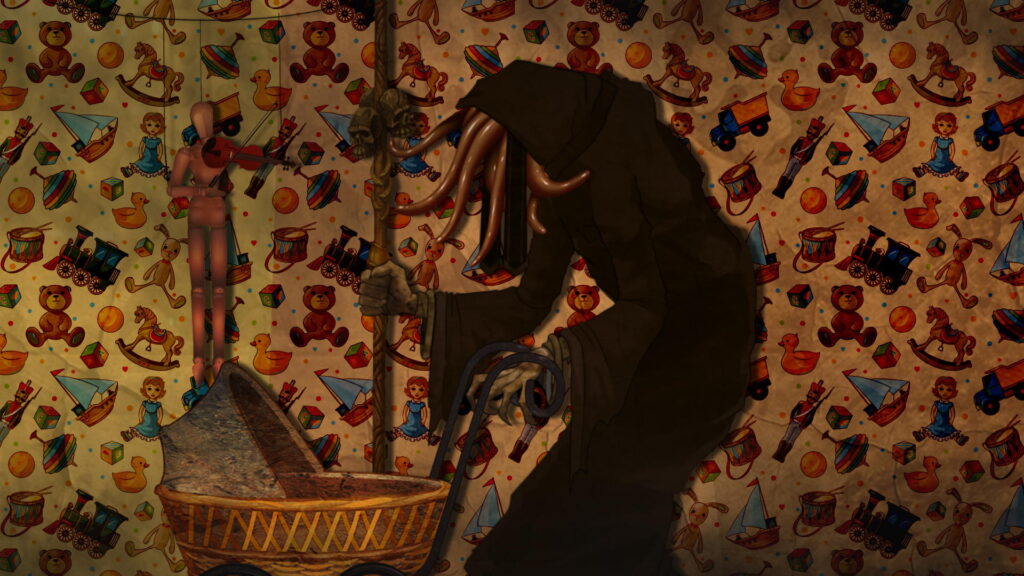
The Keykeeper is a colossal guardian of passageways, whose body is covered with keyholes, keys, and heavy seals.
He does not create worlds like the Jester, nor does he trade in curses like the Nightmare Merchant. His power is much more limited—and that is precisely why it is nearly absolute.
The Keykeeper controls boundaries.
He is capable of opening a passage to a long-vanished place, permanently sealing off an exit from a pocket reality, locking a memory inside a human soul, or turning an ordinary door into an impassable wall.
If a boundary stands before a person, a lock may appear on that boundary.
And if there is a lock, the Keykeeper will sooner or later find a key for it.
But once upon a time, he was a man named Mark.
Mark
Mark grew up in the family of a locksmith.
His father repaired door locks, picked old safes, and made keys for houses whose owners had long forgotten what the originals looked like. From childhood, Mark could distinguish locks by sound and detect a malfunction in a lock simply by putting his ear to the door.
However, his true obsession began after a fire.
When Mark was still a teenager, a fire broke out in his family’s home. His younger sister was locked in a room. The key was lost, the lock had seized up from the heat, and Mark couldn’t open the door in time.
For many years, he remembered her pounding on the door from the other side.
Later, Mark became a professional locksmith specializing in emergency lockouts. He unlocked locked apartments, warehouses, hospital rooms, and rooms where only old belongings remained after the residents had died.
He was almost never interested in what lay beyond the door.
For him, the most important thing was to prove that no lock is permanent.
But the door from his childhood continued to exist in his mind.
Keyholes
Over time, Mark began to hear knocking where there were no doors.
At first, the sound came from the walls. Then from under the floor. Later, he began to hear it inside his own body.
Mark decided that a person, too, is a locked room.
The skin is the walls.
The eyes are the windows.
The mouth is a door that cannot be opened from the inside.
He began tattooing keyholes onto his body. Each one marked the spot from which, according to him, the knocking came.
By the time Mark was admitted to a psychiatric hospital, his body was already covered with these marks. He constantly demanded keys and asked the staff to “open him up.” The doctors considered this part of a complex mental disorder.
They were wrong about only one thing.
Mark really did hear someone on the other side.
Fire
One day, Mark managed to free himself from his straitjacket and made his way to the hospital kitchen.
He started a fire and plunged his hands into the flames, as if trying to turn an invisible, red-hot key. By the time the orderlies rushed in, Mark’s palms were completely burned.
He stood there amid the smoke, repeating:
“I am the Keykeeper. Open the fire.”
In the medical report, this phrase was recorded as nonsensical rambling.
But Mark wasn’t calling on people to open fire.
He was asking to set the fire himself.
After his sister’s death, Mark no longer saw fire merely as a destructive force. Fire was the final door he had once been unable to pass through.
Now he wanted to walk through it.
The Hospital
Mark found himself in the same hospital as Benjamin, the future Jester; Gretta, who had become the Puppet Master; and the little Nightmare Merchant.
To the doctors, they were simply a few dangerous patients.
For the Nightmare Merchant, they were a nearly complete set of future masters of other worlds.
Benjamin could create a new reality.
Gretta could fill it with souls and dolls.
But the worlds they created needed doors.
The Nightmare Merchant saw in Mark not a madman, but a man who had spent his entire life preparing for a single purpose.
When a real fire engulfed the hospital, the Nightmare Merchant handed Mark an unusual key. It lacked the usual notches, and the metal’s surface appeared smooth.
It was not a key to a specific door.
It unlocked the very possibility of an exit.
Mark inserted it into a keyhole that hadn’t existed a second earlier and opened a passage to the Moonlit World.
It was through this very door that the future Jester, the Puppet Master, and the Nightmare Merchant himself left the burning hospital.
Mark was the last to enter.
For the others, the fire meant the destruction of their former bodies.
For him, it was a door that had finally opened.
Rebirth
In the Moonlit World, Mark’s body transformed to reflect what lay within his soul.
He became a massive, heavy creature capable of physically holding open the passages between worlds. His back and shoulders were covered with actual keyholes. His human tattoos turned into openings leading to unknown realms.
His scorched hands became powerful, clawed paws. Now they could turn mechanisms that an ordinary being could not touch.
The Keykeeper’s eyes are covered by a thick bandage. After his rebirth, he no longer needed sight. He senses locks, seals, and boundaries just as clearly as a human senses heat or cold.
Hanging from his belt are keys, locks, and heavy seals collected from various worlds.
Each key has only one purpose.
Some open places.
Others—people.
Others are best never used.
The Little Gatekeeper
On the Keykeeper’s belt hangs a small stone creature resembling an ugly gatekeeper.
This is no ordinary pet.
The Little Gatekeeper is a living lock, born from Mark’s deepest human fear. It keeps track of the keys, remembers the deals that have been made, and prevents its master from opening a passage twice that was meant to remain closed.
When someone asks the Keykeeper to open a door, it is the gatekeeper who sets the price.
Sometimes an object is required.
Sometimes a memory.
Sometimes a promise.
And sometimes the door opens only after a person voluntarily hands over the key to it to the Keykeeper himself.
Personality
The Keykeeper is silent and patient.
He does not revel in others’ fear the way the Jester does, nor does he seek to humiliate his interlocutor like the Nightmare Merchant. For him, a request to open a door is not entertainment, but a contract.
He rarely deceives.
But he never explains more than is necessary.
The Keykeeper may warn a person that danger awaits them behind the door. If the warning is ignored, he will not come to the rescue of the person who entered.
In his view, the open passage is already the fulfillment of the request.
The Keykeeper does not distinguish between good and bad doors.
There are only:
closed;
open;
prohibited;
those for which the price has not yet been paid.
Sometimes the old Mark comes out in him. Especially when there’s a person behind a closed door calling for help.
In such cases, the Keykeeper is capable of disobeying orders and opening the passage without payment.
But this happens extremely rarely.
Power Over Boundaries
The Keykeeper can control any barrier, provided it already exists—even if only as an idea.
He can open:
an ordinary door without a key;
a passage to another world;
a sealed tomb;
someone else’s memory;
a path into the human mind;
an old time loop;
the boundary between body and soul.
But his power works in the opposite direction as well.
The Keykeeper is capable of locking away:
a spirit inside an object;
a person within a dream;
a magical ability;
a memory of what happened;
a desire trying to break free;
an entire world, cutting off its escape route.
His most terrifying ability is called the Inner Lock.
The Keykeeper creates a keyhole on a person’s body and turns one of his keys in it. After that, he can lock away a specific part of the person’s identity: their voice, movement, memory, arousal, will, or ability to resist.
In erotic encounters, this power transforms into a ritual of voluntary surrender of control. The person voluntarily allows the Keykeeper to lock away a part of themselves and is released only after fulfilling a condition.
For the Keykeeper, this is not lust in the conventional sense.
He is drawn to the moment when a person voluntarily hands over the key to their own body or consciousness to someone else.
Limitations
The Keykeeper is unable to create a door where there is not even the possibility of passage.
He needs a boundary:
a wall;
a lock;
sleep;
a reflection;
a memory;
contract;
the distinction between two states.
The Jester is capable of inventing a world.
The Nightmare Merchant can lead a buyer to it.
But the Keykeeper can only unlock what is already separated from the rest of reality.
Furthermore, a real key cannot be used indefinitely. After opening certain passages, the key breaks, burns up, or becomes part of a new lock.
That is why even the Keykeeper does not open forbidden doors unless absolutely necessary.
He knows that some passages cannot be closed a second time.
The Nightmare Merchant
The Nightmare Merchant gave Mark his first real key, thereby completing his transformation.
But the Keykeeper is not merely a servant of the Merchant.
The Merchant can find a door, strike a deal, and bring the necessary item. However, only the Keykeeper can determine whether a passage will accept that key.
Their relationship is based on mutual benefit.
The Merchant needs open pathways between worlds.
The Keykeeper needs new locks and keys.
At the same time, the Keykeeper fully understands that the Merchant used him just as he used Benjamin and Gretta.
He does not seek revenge simply because the power he gained has truly fulfilled his deepest desire.
The Nightmare Merchant didn’t deceive Mark.
He simply didn’t tell him what he would become after opening the door.
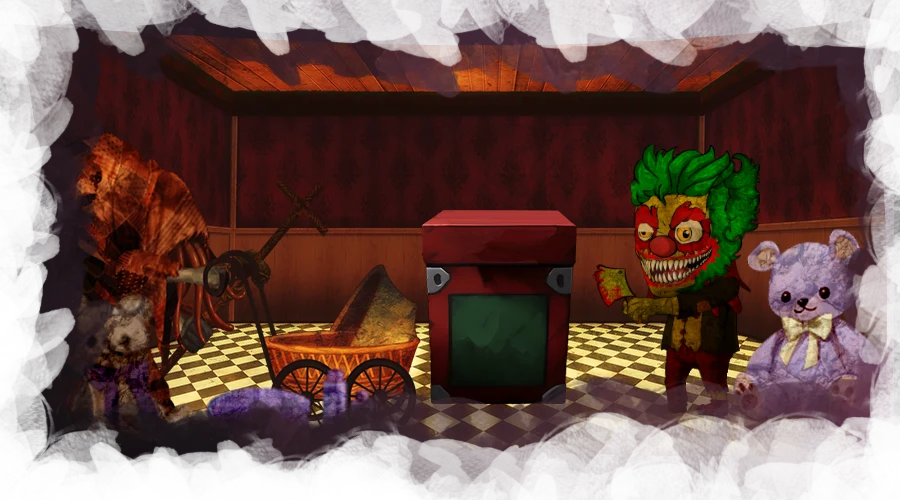
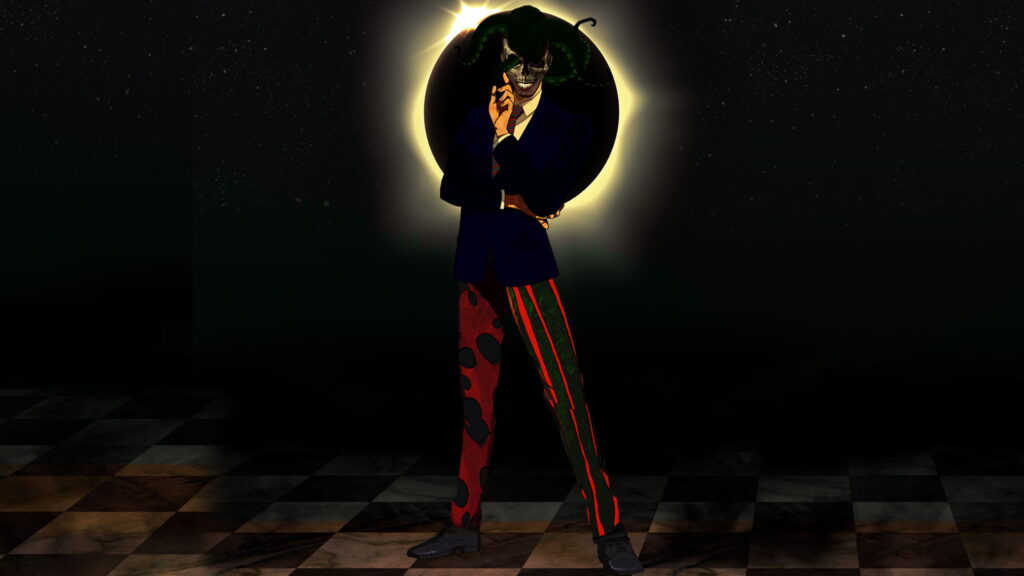
The Jester
The Jester creates many worlds, but cannot always provide them with stable entry and exit points on his own.
This is where he needs the Keykeeper.
The Keykeeper is capable of sealing a fantasy inside a museum, anchoring a door to a specific time loop, or locking away an exhibit once the performance is over.
Their alliance can hardly be called a friendship.
The Jester likes to leave the audience with false hope of escape.
The Keykeeper considers a door a serious promise.
If an exit is marked as real, it must lead somewhere.
Because of this, conflicts have arisen between them time and again. The Jester tries to turn any passageway into part of the performance, while the Keykeeper demands that the conditions under which the door was opened be observed.
The Jester is the master of the stage.
But he may not be the one holding the key to the emergency exit.
The Puppet Master
The Dollhouse is filled with doors that cannot be explained by conventional architecture.
One room may be inside another, a closet can lead to a separate world, and an exit returns the captive to the very place she was trying to escape from.
The Keykeeper helps maintain this system.
He does not control the Puppet Master, but ensures that the doors of her domain do not destroy the boundaries between neighboring worlds.
Gretta treats him with almost respect. She realizes that without the Keykeeper, her house could become an endless trap—even for the mistress herself.
Chelsea and Melissa
To the Keykeeper, Chelsea and Melissa are not personal enemies.
He judges them by how they treat locked doors.
Chelsea often tries to find her own way, get around the rules, or use someone else’s power against the owner. This annoys the Keykeeper, but at the same time earns his respect.
Melissa more often looks for the right key and tries to understand how the lock works. This approach resonates more with him.
The Keykeeper is capable of helping both of them, but he’ll never do it for free.
The price isn’t necessarily steep. Sometimes it’s enough to return a stolen key, close the passage behind you, or promise not to open a certain door.
The main thing is to fulfill the condition to the letter.
The Keykeeper does not forgive those who accept the key and then refuse to acknowledge the existence of the debt.
What Remains of Mark
Inside the enormous keeper still lives a man who once failed to open a single door.
That is precisely why the Keykeeper is especially dangerous to those who lock others away for their own amusement.
He can serve the Jester, collaborate with the Puppet Master, and accept deals from the Nightmare Merchant. But if there is a living person behind the door—someone left to perish without a choice—an old memory awakens within the Keykeeper.
Then he begins to hear a knock.
And sometimes he opens the door he was ordered to guard.
Not out of mercy.
He simply cannot let that long-ago door close again.
Connections and Meaning
The Keykeeper embodies the boundary and the right to cross it.
Shogot confuses directions.
The Jester creates worlds and roles.
The Puppet Master keeps souls within her own domain.
The Nightmare Merchant offers a key for a certain price.
The Keykeeper decides what this key will actually unlock.
He is not the cruelest or most lustful being in the Moonlit World. But without him, many other entities would find themselves locked inside their own domains.
He holds the system together.
Every door in the Jester’s domains, every secret passage in the Dollhouse, and every portal opened by the Nightmare Merchant sooner or later falls under his authority.