| NATURE | A mediator between worlds |
|---|---|
| DOMAIN | The Wavering Isles and Passages of the Moonlit World |
| GOODS | Cursed Objects, Roles, Routes, and Soul-Time |
| MAIN POWER | The ability to see hidden desires and suitable vessels |
He almost never lies outright. It’s enough to tell just enough of the truth for the buyer to choose the worst price on their own.
Other Names: Little Nightmare Merchant, Petty Clown, Antique Dealer
True Name: Unknown
Nature: A borderland entity, dealer in curses, and mediator of transformations
Presumed Master: The Dark Lord
Known Habitat: The Wavering Isles
Primary Tools: Cursed objects, keys, caskets, portal chalk, silver bullets, and Soul-Time
Danger Level: Extremely High
Key Trait: Never appears to be the chief culprit behind what is happening
General Description
The Nightmare Merchant is one of the most elusive and dangerous entities in the world of Chelsea.
At first glance, he seems like nothing more than a small, ugly clown: lecherous, crude, hungry for entertainment, and not always particularly smart. He appears for a few minutes, offers a shady deal, hands the heroine the item she needs, and vanishes before it becomes clear exactly what happened.
However, almost every time he appears, he leaves a trace capable of changing the fate of the entire world.
It was the Nightmare Merchant who took the mask from the remains of the executed Jester and placed it in a box. Centuries later, he gave this box to Benjamin, helped the new Jester escape from the hospital, and hastened his final transformation.
He taught the future Puppet Master how to pass through reality, explained the nature of Soul-Time, and helped her claim a portal of her own between worlds.
He gave a special key to the Keykeeper, allowing him to open the door to the Moonlit World.
He sells weapons against the very creatures he himself helps to set free.
He warns the heroines of disasters, but almost never prevents them on his own.
The Merchant does not appear at the center of the story, but on its periphery—precisely at the moment when a person needs an item, a path, or knowledge for which they will later have to pay the price.
Not a Merchant of Goods
The title “The Nightmare Merchant” does not mean that he simply sells terrifying dreams.
He sells the opportunity to turn an inner nightmare into reality.
His goods rarely have intrinsic value. It is not the object itself that matters, but what it will connect the new owner to.
Benjamin’s box was no ordinary mechanical toy. It connected a person to the remains of the Jester and opened the way to a new reality.
The Portal Chalk did more than draw doors. It led people into worlds where predetermined roles were already waiting for them.
The Key to the Moonlit World was useless without the Keykeeper.
The Dollhouse remained merely an object until human desires filled it with souls.
The Merchant does not create desires and fears from scratch. He finds them within a person, gives them a suitable form, and allows the owner to take the final step on their own.
That is why his deals almost always appear to be voluntary.
The person buys the box themselves.
They put on the mask themselves.
They walk through the painted door on their own.
They accept the offer on their own.
The Merchant merely ensures that the necessary item is nearby at the right moment.
Appearance
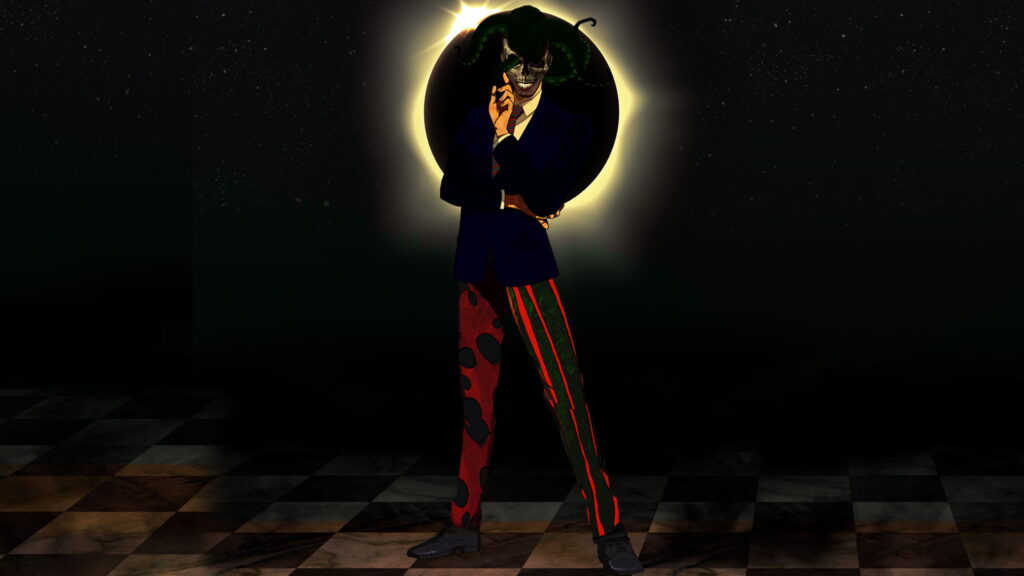
The Nightmare Merchant takes the form of a small clown with a disproportionately large head.
His face is covered in red or white makeup. Bright spots are visible around his eyes, and his mouth is stretched into an excessively wide smile, revealing a multitude of sharp teeth.
The hair or growths on his head are a rich green color and resemble a clown’s wig, tongues of flame, and soft tentacles all at once.
He wears an old, colorful suit pieced together from red, green, and dark fabric. Sometimes his clothes look bright and almost festive. At other times, the Nightmare Merchant appears dirty, scorched, and like a theatrical puppet come to life.
His body is small and does not physically strike one as a serious threat. The Nightmare Merchant takes full advantage of this. People look down on him, considering him a lecherous freak or a lowly servant of a more powerful entity.
It is unknown whether this form is his true body.
Perhaps the clown’s form is merely a convenient commercial mask, allowing him to appear among people without revealing his true nature. But it is in this very form that he appears in different eras, which means the image of the clown holds special significance for him.
Unlike the Jester, who was indeed a human clown, the Nightmare Merchant was probably never a human performer.
For the Jester, the clownish image is a remnant of his former self.
For the Nightmare Merchant, it is a uniform.
Age and Origin
The true origins of the Nightmare Merchant are unknown.
He already existed in 1585, when, after the Jester’s execution, he appeared at the site of the bonfire and took his mask. Consequently, the Nightmare Merchant is significantly older than the Jester’s modern incarnation and was not created by his theater.
In a later era, he moves freely on Earth, finds himself in a psychiatric hospital, travels between worlds, and calls the Wandering Islands his home.
He knows the laws of the Lunar and Moonlit Worlds, understands the nature of the soul’s transformation, and is able to recognize people from whom new entities might emerge.
In hospital records, he is described as a patient of incredibly short stature who shows no overt aggression. He demands to be taken to the Jester or to have the box—which he claims to carry in his pocket—handed over to him, even though the staff cannot see any such object.
This reveals an important characteristic of the Merchant: some of his possessions may exist beyond ordinary material perception.
Just because a person cannot see a product does not mean the product does not exist.
The Mask of the Executed Jester
After the Jester’s public execution in 1585, all that remained of him was a charred skull with a mask.
That night, the Nightmare Merchant came to the bonfire, removed the mask, and placed it in a box with the little devil. He did not attempt to revive the deceased on the spot, nor did he restore his human body.
Instead, the Nightmare Merchant transformed the remnants of his identity into a portable curse.
This act best reveals his true nature.
He is capable of seeing value where others see only a corpse and ashes.
The Jester’s suffering, his humiliation, his love for the stage, his lust, his attachment to Chelsea, and his terror of the crowd became raw material. The Merchant preserved all of this not out of compassion, but because something far more powerful could be created from a broken human soul.
He didn’t save the Jester.
He made an investment in him.
Benjamin and the Box
Centuries later, the Nightmare Merchant appears before Benjamin in the guise of a strange antique dealer wearing a clown mask.
He sells a box worth approximately one hundred thousand for just fifteen cents and keeps repeating that he “lost its owner.”
The deal clearly made no economic sense.
Benjamin was not a buyer in the conventional sense. He was the chosen vessel.
After the mask appears and the two artifacts come into contact, Benjamin begins to have dreams in which he creates his own reality, and his hidden fantasies take physical form. Then the mask merges with his face, Nick’s fear fills the box, and Benjamin’s former personality begins to crumble.
The Merchant later helps him escape from the hospital.
Thus, he participates in all the key stages of the transformation:
hands over the box;
ensures the mask’s appearance;
allows the curse to take effect;
frees the bearer from the hospital;
helps him reach the new world.
At the same time, he never directly carries out Nick’s murder.
This is the Merchant’s typical method. He offers a person an opportunity, but makes them take the final action that completes the deal.
The Psychiatric Hospital
The hospital became one of the most important hubs of his activities.
The following people found themselves in the same place:
Benjamin, who was already turning into the Jester;
Mark, who called himself the Keykeeper;
the future Puppet Master;
the Nightmare Merchant himself.
It’s hard to call this a coincidence.
Each of them possessed a quality necessary for the future system of transitions:
The Jester could create fantasies and worlds.
The Keykeeper could open doors.
The Puppet Master could transform souls and keep them captive in her own house.
The Merchant understood how to combine their abilities.
The future Puppet Master states plainly that the Nightmare Merchant taught her to pass through material reality into the Moonlit World. He promised her the Dollhouse beyond the threshold if she helped free the Jester and the Keykeeper.
The Merchant wasn’t just saving his comrades.
He was assembling a team of entities, each of which was to take its own place in the system of passages between worlds.
Soul-Time
The Nightmare Merchant possesses rare knowledge of Soul-Time.
Soul-Time is a special power that allows beings from the Lunar and Moonlit Worlds to exist on Earth. It is drawn from human experiences, secret desires, fears, and participation in games created by entities.
It is the Merchant who explains to the future Puppet Master that without this power, her physical form will remain bound to the earthly world. To complete the transition, she must obtain Soul-Time from Nurse Ginger’s desires.
He understands not only how to extract this energy but also its practical application:
extending an entity’s stay on Earth;
completely crossing the boundary between worlds;
solidifying a new form;
powering portals;
maintaining the cursed domains.
It is unclear whether the Nightmare Merchant needs Soul-Time as other creatures do, or merely administers it on behalf of his master.
However, his constant inclination toward deals based on fear, shame, and erotic desires suggests that human experiences are both a source of pleasure and a resource for him.
Lust
The Nightmare Merchant is extremely lustful.
Unlike the Jester, whose lust is tied to theatricality, romanticism, and the desire to keep a specific woman, the Nightmare Merchant views intimacy as entertainment, currency, and part of a deal.
He can exchange items the heroine needs for sexual favors.
He offers silver bullets—capable of protecting against infernal creatures—on the following terms:
One bullet—for one time.
When the heroine runs out of portal chalk, the Nightmare Merchant is willing to share some with her, but immediately demands that she “entertain” him.
Yet his lust does not make him a mere animal.
It is built into his business philosophy.
The Merchant particularly enjoys the moment when a strong or proud woman is forced to turn to him for help. He relishes not only the physical act but also the reversal of power: just a short while ago, the heroine despised this little clown, and now it is he who holds the last bullet, the key, or the piece of chalk.
However, he is dangerous not because he always uses force.
Much more often, the Nightmare Merchant creates a situation in which refusal seems too costly.
He doesn’t take away the choice.
He makes one of the options significantly worse than the others.
Sales Philosophy
The Nightmare Merchant rarely demands conventional money.
A price in coins is almost meaningless to him. A box worth a fortune was sold for fifteen cents, because the real payment was to be Nick’s fear, Benjamin’s body, and the birth of a new Jester.
The true price of his goods may lie in:
fear;
pleasure;
humiliation;
a service rendered;
the liberation of another being;
opening a portal;
human transformation;
a future debt;
a change in the fate of the entire world.
Therefore, the buyer rarely understands the full cost at the moment of the transaction.
The Merchant fulfills his promises literally. He truly provides the bullet, chalk, key, or route—but the object comes with consequences the buyer never requested.
He respects the terms of the transaction.
He does not respect people.
Portals and Morality
The Merchant moves freely between worlds and can open glowing passages.
He claims he is heading home to the Wavering Isles and invites the heroine to accompany him. However, he warns her that where she ends up will depend on her morality.
This means that some of his portals do not have a single, fixed exit.
They assess a person’s state and direct them to a space that corresponds to the choices they have made.
The Merchant does more than know the geography of other worlds.
He understands how a person’s inner qualities translate into a direction of travel.
For him, morality is not a philosophical category. It is a coordinate.
That is precisely why he closely observes Chelsea’s and Melissa’s decisions. Their choices determine not only their character but also which doors are capable of opening before them.
The Wavering Isles
The Nightmare Merchant calls the Wavering Isles his home.
Very little is known about them. The name itself suggests a space without a fixed position: islands moving between layers of reality or drifting within the Lunar World.
Perhaps that is why the Merchant is so well-versed in transitions.
For a being whose home is not anchored in one place, moving between worlds is not an exception but a natural state.
The Wavering Isles may also explain his lack of a permanent domain.
The Jester has a theater.
The Puppet Master has a house.
The Keykeeper has doors.
The Merchant is not tied to a single building. His home travels along with the system of worlds, and he himself appears wherever a profitable deal is on the horizon.
The Dark Lord
The Merchant mentions his own master several times.
He says he was looking for the woman from the Dark Lord’s nightmares. In another conversation, he explains that his master has no use for mad jesters as competitors.
This suggests that he serves the Dark Lord specifically, although the nature of this subordination remains unknown.
The Merchant may be:
a servant of the Dark Lord;
his agent;
a supplier of rare entities;
a scout;
a collector of human desires;
a mediator with his own free will.
He clearly carries out assignments, but does not come across as a spineless slave.
The Nightmare Merchant is capable of growing tired of tasks, pursuing personal pleasures, striking his own deals, and even helping people—as long as it doesn’t conflict with his master’s interests.
Of particular significance is the woman from the Dark Lord’s nightmares.
The Nightmare Merchant searches for her across different worlds and asks that a woman who merely resembles the sought-after image be sprayed with a special liquid. This shows that he is able to recognize recurring faces and reflections of a single personality across different realities.
For him, a person may be valuable not only in and of themselves, but also as a possible reflection of someone else’s dream.
Parity Between Worlds
The Nightmare Merchant is not interested in the complete destruction of Earth.
He explains that certain balances exist between the worlds. If one world turns into an uncontrolled, ghostly brothel, the changes will affect other realms as well.
That is precisely why he helps prevent the Jester’s fantasies from fully materializing. Not out of compassion for people, but because the theater’s expansion would disrupt the balance and create a rival to his master.
This makes the Merchant far more interesting than your typical villain.
He is capable of helping the heroine against a terrible threat, while remaining a completely amoral entity.
His side is neither good nor evil.
His side is the order that serves his interests.
If freeing the monster is necessary to maintain the balance, he will free it.
If it’s necessary to weaken a former ally, he’ll tell the heroine how to do it without hesitation.
He sells out to both sides, but makes sure neither gains too much power.
Relationship with the Jester
The bond between the Merchant and the Jester runs much deeper than a typical alliance.
The Merchant:
took the mask after the execution;
turned it into the basis of the curse;
found Benjamin;
gave him the box;
helped him escape;
facilitated the transition to the Moonlit World;
later attempted to limit the Jester’s ability to bring his fantasies to life.
The Nightmare Merchant is simultaneously the creator of the modern Jester, his savior, his mediator, and his overseer.
He likely views the Jester as a successful but dangerous project.
As long as the theater brings fear, desires, and new transitions, the Jester is useful.
But if he attempts to engulf the earthly world and disrupt the balance, the Merchant is ready to aid his enemies.
He feels no human loyalty toward the Jester.
To him, the Jester is a very valuable commodity who has been allowed to believe that he has become the shop’s owner.
Relationship with the Puppet Master
The future Puppet Master becomes one of the Merchant’s most successful apprentices.
He does not transform her with his own hands. Instead, he shows her the way, explains why Soul-Time is necessary, and offers a bargain:
She helps free the Jester and the Keykeeper;
he helps her fully transition to another world and gain her own domain.
After the fire at the hospital, she walks through the door and is transformed in accordance with her soul. She then receives the Dollhouse—a portal that she can fill with new souls.
This feels less like a random act of kindness and more like an appointment to a position.
The Merchant found a person with the right desires, helped her finally renounce her human life, and put her in charge of one of the crossings.
He can do more than just sell items.
He creates new masters for cursed places.
Relationship with the Keykeeper
The Nightmare Merchant possesses the keys, but does not act as the Keykeeper on his own.
During the fire, it is he who hands the key to the Moonlit World to Mark. After that, the Keykeeper opens the door through which the others pass.
This illustrates the Nightmare Merchant’s guiding principle.
He rarely does all the work on his own.
The Merchant finds the person best suited for a specific task, hands them the necessary tool, and gets the desired result.
The key may belong to the Merchant.
But it is the Keykeeper who must turn it.
Chelsea and Melissa
To the Nightmare Merchant, the sisters are clients, prey, and a source of instability all at once.
He may insult Chelsea, offer her lewd deals, and try to drag her into the circus. At other times, he supplies her with weapons, chalk, or information necessary to rescue Melissa.
When Chelsea demands her sister back, the Merchant informs her that Melissa is with the Green Jester, tosses her a portal chalk, and vanishes. Technically, he’s helping. But it was he and his allies who had repeatedly sent invitations before and ultimately slipped the chalk to Melissa herself.
So the question remains: did the Nightmare Merchant really just foolishly show Chelsea the way, or did he want her to go to the big top from the very beginning?
Chelsea considers him petty and too dim-witted, since he unwittingly helps her reach her sister.
But for an entity that has been connecting people, curses, and worlds for centuries, such a mistake seems suspiciously convenient.
Perhaps the Merchant does indeed sometimes become careless due to lust and overconfidence.
Or perhaps Chelsea has ended up exactly where she was meant to go.
Behavior
The Merchant is rude, mocking, and deliberately unpleasant.
He makes no attempt to appear like a majestic demon. He might swear, giggle, haggle over trifles, and act like a lecherous circus freak.
This behavior serves several purposes at once.
First, it hides his intelligence.
Second, it causes the other person to underestimate the threat.
Third, it turns a serious metaphysical deal into something almost mundane.
It’s easier for a person to accept a piece of chalk from a despicable clown than to sign a formal contract with an ancient entity. But the consequences remain just as real.
The Merchant knows how to tell the truth in a way that makes it sound like a joke.
And he knows how to convey a threat in a way that makes it seem like a joke.
Abilities
Traveling Between Worlds
The Nightmare Merchant is capable of opening portals, vanishing without a trace, and traveling between the Earth, the Moon, and the Moonlit Worlds.
Working with Cursed Objects
He can find, alter, store, and transfer artifacts capable of connecting people to other realities.
Creating Vessels
The Merchant identifies people whose desires and vulnerabilities make them suitable vessels for curses.
Knowledge of Soul-Time
He understands how to extract and use the energy of human experiences.
Vision of Desires and Nightmares
The Merchant can uncover people’s secret desires and use them as material for a deal or a transformation.
Hiding Objects
Some of his goods can remain invisible or exist outside of ordinary physical space.
Moral Navigation
His portals can direct travelers to different places depending on their decisions and inner state.
Vanishing
He can leave a place without moving in the usual way, leaving no traces or footprints.
Mediation Between Entities
The Merchant is able to bring together people, artifacts, and creatures that would never have met without him.
Limitations
The Merchant is very powerful, but does not act as an absolute ruler.
He prefers mediation and deals to direct violence. It is possible that some transformations require the person’s own voluntary action.
Benjamin had to put on a mask.
The future Puppet Master had to obtain Soul-Time.
The Keykeeper had to open the door.
Chelsea had to use the chalk herself.
This may not simply be a habit, but a limitation on his power. The Merchant is capable of paving the way, but the final step must be taken by the one whose fate is to be changed.
He is also bound by his master’s interests and the balance between the worlds.
Finally, his lust is a true weakness. The desire for immediate gratification sometimes causes the Merchant to bargain too cheaply, reveal useful information, or let the heroine get closer than he should.
But it's dangerous to rely on this weakness.
Perhaps even his failures have long been factored into the price of the deal.
What Does He Want?
The Nightmare Merchant does not seek to rule the Earth himself.
A world filled with fears, desires, curses, and closed doors is more profitable for him. Such a world constantly creates new customers.
He wants to:
maintain movement between worlds;
maintain a favorable balance;
find suitable hosts;
create new curses;
collect Soul-Time;
carry out the Dark Lord’s orders;
enjoy yourself;
prevent any single entity from completely taking over the system.
If the Jester brings all his fantasies to life and turns Earth into his own theater, trade will come to an end. Everything will belong to a single master.
This is not in the Merchant’s interest.
He doesn’t want the end of the world.
He needs an endless market for human weaknesses.
Connections and Meaning
The Nightmare Merchant embodies temptation as a deal.
The Jester turns life into a spectacle.
The Puppet Master turns a person into a toy.
The Keykeeper opens doors.
Shogot confuses the passages.
The Merchant decides who gets a mask, who gets a key, who gets chalk, and who must encounter the creature on the other side.
He is not the most powerful being in the world of Chelsea.
But he is the one capable of putting the strongest beings in their proper places.
His danger lies in his lack of a stage of his own. When the Jester appears, all attention goes to the Jester. When the Dollhouse comes to life, people fear its mistress. When the door opens, everyone looks at the Keykeeper.
Almost no one remembers the little clown who introduced them to each other.
That is exactly how he prefers it.