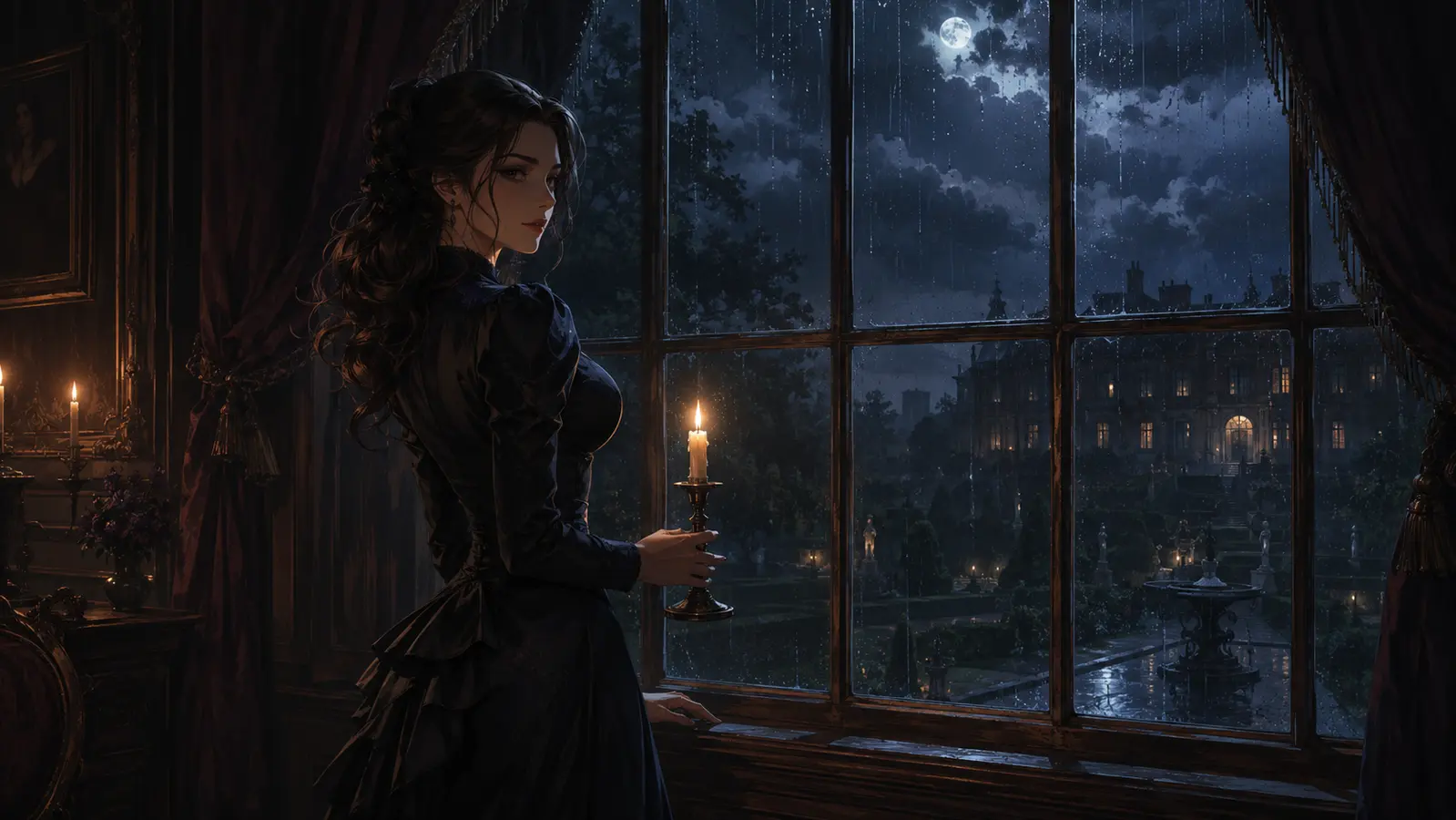
| NATURE | A witch of the House of Maria; creator of portals |
|---|---|
| DOMAIN | Estate, garden, realm of dreams |
| MAIN POWER | Taming entities through desire and true names |
| MAIN WEAKNESS | Curiosity, reliance on her own system of spells |
Agnet transformed the family estate into a nexus between worlds and left Chelsea not a fortune, but an initiation disguised as a will.
Full Name: Agnet
Other Titles: Mistress of the Estate, Spirit Collector, Predecessor Witch
Nature: Human, hereditary witch; after her disappearance, a ghostly captive of the Interworld
Lineage: Descendant of Maria; aunt of Chelsea and Melissa
Main Domain: The estate and the infernal collection within it
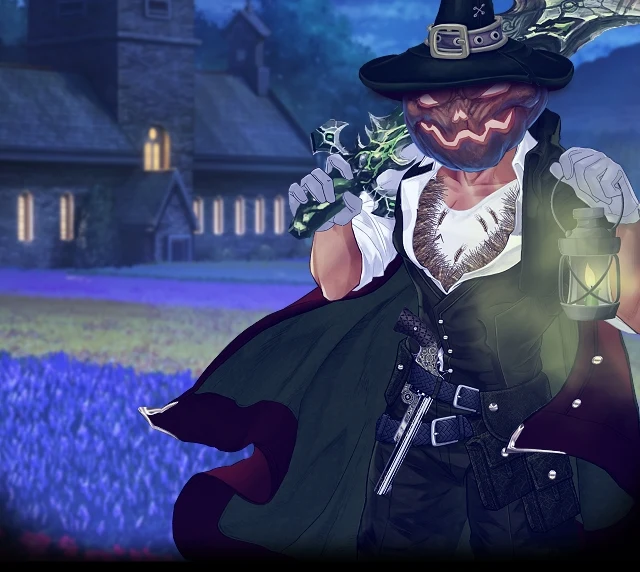
Known Guardian: Jack, the Candle Demon
Key Trait: Able to understand the desires of an unknown entity, discover the rule governing its existence, and transform a threat into part of a controllable system
Danger Level: Extremely High
Moral Assessment: Ambiguous; capable of saving, protecting, and preserving souls, but willing to accept risk, vice, and the desires of others as natural parts of magical knowledge
General Description
Agnet is the hidden architect of nearly the entire story of Chelsea.
She is rarely at the center of events, yet her actions set the major events of the chronicles in motion. Agnet gathers spirits and demons, transforms the estate into a nexus between worlds, takes Jack in, creates portals, prepares Chelsea’s inheritance, and continues to shape the fates of her nieces even after her own disappearance.
At first glance, her story begins in the Teutoburg Forest, where a young Agnet met a beautiful woman in white and first learned of the existence of the otherworld.
But when viewed in its entirety, it becomes clear: Agnet did not found a new tradition of witchcraft.
She restored a nearly severed connection to the ancient lineage of Maria.
The woman in white was not a chance forest lover or a wandering ghost. She was part of an ancient family ritual—the last way to pass on the gift if the elder witch had not had time to train the younger one.
However, Agnet was given only the ability to see and sense the hidden.
She did not receive a ready-made grimoire.
She didn’t receive a list of creatures.
She didn’t know the stories of Maria, Jack, Henri, the Jester, and Johan Weber.
Almost everything Agnet later learned, she discovered on her own.
That is precisely why her achievements are particularly significant.
She tamed creatures whose true nature she didn’t even understand.
Appearance
Despite her age, Agnet has retained a striking youthfulness and attractiveness.
She has long silvery-white hair, bright green eyes, soft features, and a lively, sensual expression. She resembles Chelsea’s older sister more than an elderly relative who has lived a long and eventful magical life.
Agnet’s white hair does not appear to be a typical sign of aging. It seems to emphasize her connection to the Woman in White, the spirit world, and her family’s legacy.
The exact reason for her youthfulness has not been revealed. It is likely sustained by several factors at once:
an inherited gift;
a constant exchange of power with the spirits;
living alongside beings not bound by human time;
portals she has created;
practices in which desire, physical pleasure, and magic become a single source of energy.
Agnet does not give the impression of a woman desperately clinging to her youth.
She simply stopped submitting entirely to ordinary time long ago.
Her beauty is neither a mask for a decaying body nor an illusion meant to seduce. She has retained genuine vitality, curiosity, and carnal energy.
For Agnet, sensuality has never been a separate trait of her character.
It was part of her magic.
The Almost Lost Line
The Line of Maria
Agnet is a distant descendant of Maria—a herbalist witch who lived in 1585.
Once upon a time, the gift was passed down within the family from the eldest woman to the youngest. Along with it, the heiress was supposed to receive knowledge of herbs, spirits, protection, desires, and the rules for interacting with beings from other worlds.
But the connection came close to being severed completely on several occasions.
Maria received only part of her grandmother’s knowledge. Her grandmother did not have time to complete her training, and the woman in white never came to Maria herself. Therefore, Maria could sense the supernatural and knew about herbs, but she had not yet mastered the protection of spirits.
Centuries later, the rift grew even deeper.
Agnet grew up without understanding her own origins. Her mother did not tell her about their lineage of witches and did not pass on a full initiation. The reasons for their constant moves also remained a mystery to the young woman.
Then the ancient family mechanism kicked in on its own.
In the Teutoburg Forest, a woman in white approached Agnet.
Later, when Chelsea told Maria that her aunt had become a witch after meeting the woman in white, Maria immediately recognized the description. She explained that such an initiation had been practiced in their family since time immemorial: if the elder did not manage to pass on the gift to the younger, a woman in white would appear.
Not a Beginning, but a Return
For Agnet herself, the encounter in the forest was truly a beginning.
Before that, Agnet had no idea she belonged to a lineage of witches. She did not understand the dreams, spirits, and inexplicable sensations that had accompanied her life.
But for the lineage, this was not the birth of a new witch.
It was the return of a lost heiress.
The woman in white did not bestow a foreign power upon Agnet. She unlocked what already flowed in her blood.
At the same time, the full tradition was not restored instantly.
Agnet received a gift, but no explanations.
She could see the hidden, sense the presence of entities, and make contact with them, but often did not know
their true names;
their origins;
their place in the structure of the worlds;
their past human history;
their connection to her own lineage;
the reasons why they appeared together.
Agnet did not continue her formal education.
She rebuilt her witchcraft practice almost from scratch.
The Woman in White
The First Encounter
When she was young, Agnet’s family moved to the Upper Palatinate.
To the young woman, the place seemed boring and dreary. Seeking relief from the monotony, she walked alone through the forest despite the locals’ warnings.
About half a year later, Agnet met a beautiful stranger dressed entirely in white.
The woman became her first lover and her first true guide to the world that exists beyond human reality.
When Agnet’s family had to move again, she returned to the forest to say goodbye. Agnet could not hold back her tears, but the stranger merely smiled.
When asked why she was so cheerful before their final parting, the woman replied that from now on, all Agnet would have to do was go to sleep and call out to her.
Agnet decided that this was a beautiful metaphor.
But after the move, she lay down, thought of her beloved—and she appeared in the flesh.
That’s when Agnet realized that the woman in white was no ordinary living person.
After that encounter, secrets hidden from most people began to unfold before her.
A Mentor Through Pleasure
Agnet’s initiation was not a dry ritual of passing on words and formulas.
The woman in white unlocked her gift through intimacy, trust, pleasure, and sleep.
This shaped all of Agnet’s subsequent magic.
She never viewed the body as inferior to the mind or the soul.
For her, the body is capable of:
sense the nature of a being;
establish a connection;
receive energy;
soothe;
subdue;
convey one’s will;
open doors closed by fear and violence.
Agnet’s eroticism is not merely a decorative element of her image.
It is the foundation of her magical language.
Where Henri saw sin and Weber saw a quantifiable resource, Agnet saw a form of communication.
The True Nature of the Woman in White
Who exactly the stranger was remains unknown.
She could have been:
an ancient witch of the clan;
the spirit of the first woman in the family line;
the guardian of a hereditary gift;
an entity that takes on a form appropriate for each heiress;
the living embodiment of the ritual;
the collective memory of the women of the lineage.
But her function is clear.
She returns the witch to the family when the usual chain of instruction is broken.
For Agnet, the woman in white became at once:
a lover;
a mentor;
a guide;
the first being to whom she willingly opened herself;
proof that desire and magic can be one and the same.
From this encounter grew Agnet’s guiding principle:
fear closes the door, while desire allows one to see what lies beyond it.
The Great Family Circle
Agnet’s story forms a complex temporal loop.
Maria is Agnet’s ancient ancestor.
Agnet passes on her legacy and gift to Chelsea.
Chelsea travels back to 1585 and meets Maria herself.
Maria has not yet mastered the full system of spirit protection, so Chelsea offers to teach her what she herself indirectly learned from Agnet.
After saving Jack, Chelsea asks Maria to keep him close to their family.
Centuries later, Jack recognizes this lineage in Agnet and follows her.
This forms a closed sequence:
Maria and the ancient lineage → the woman in white → Agnet → Chelsea → Chelsea’s return to the past → Maria’s training → Jack’s preservation → Maria’s descendants → Agnet.
It is impossible to determine exactly where it all began.
Agnet received the gift from the family entity.
Chelsea received it from Agnet.
Maria received the missing knowledge from Chelsea.
And the future lineage descends from Maria herself.
The witch lineage does not simply pass knowledge from the past to the future.
It sustains its own existence through time.
Agnet’s Personality
Agnet is curious, sensual, independent, and almost pathologically fearless.
She does not view spirits as sacred forces to be revered. Nor does she consider them evil that must be mindlessly destroyed.
She is curious:
where the creature came from;
what it wants;
what causes it to fear;
how it perceives humans;
what it eats;
whether it’s possible to negotiate;
where to anchor it;
what desire makes it controllable;
what will happen if the customary rules of the ritual are broken.
Agnet is a researcher, but her method is the opposite of Weber’s.
Weber tries to separate the object from himself, measure it, and place it inside a mechanism.
Agnet enters the circle herself.
She uses her mind, will, body, arousal, and pleasure as parts of a single experience.
Her practice cannot be fully replicated according to a blueprint.
Agnet herself is always the main tool.
Erotic Magic
Agnet is extremely sensual and uninhibited.
But her eroticism does not mean she readily relinquishes control.
On the contrary, it is precisely in moments of intimacy that her power is most clearly evident.
She is not ashamed of her desire and therefore does not allow a being to use shame against her.
She does not try to feign innocence in front of a lustful spirit.
She does not back down when the ritual becomes physical.
She does not consider pleasure a defeat.
For her, surrendering to a sensation and surrendering to a being are two entirely different things.
Agnet can let the monster get close, give it what it wants, experience pleasure, and still remain in control of the situation.
She understands that many beings expect one of two things from a woman:
fear;
submission.
Agnet gives them neither.
She responds with desire, but reserves the right to make her own decisions.
That is precisely why beings accustomed to subjugating people through lust often find themselves bound to her.
The Philosophy of Desire
Agnet understands spirits through their desires.
She rarely begins with an exorcism or a direct attack. First, she figures out what the entity is after, then allows it to get a part of what it wants—and uses that moment of satisfaction to establish a connection.
This is how she came to the conclusion that passion is not the opposite of reason.
On the contrary, passion reveals a being’s true nature faster than any words ever could.
This philosophy is articulated in her diary:
“People condemn passions, forgetting that philosophy lights its torch from their fire.”
Agnet does not attempt to transform the monster into a virtuous creature.
She makes the creature predictable.
If the creature is hungry, one must understand exactly what it feeds on.
If it is lustful, one must find out where pleasure ends and addiction begins.
If it loves music—don’t interrupt the melody.
If it’s attached to a mirror—leave the mirror in the right place.
If it follows its own heart—hide the heart.
For Agnet, there is no such thing as a completely inexplicable monster.
There is only a rule she has not yet discovered.
The Influence of the Marquis de Sade
Agnet read extensively and particularly admired the novel *Juliette, or The Successes of Vice*.
She viewed it not merely as erotic literature, but as a philosophical justification for personal freedom, resistance to religious morality, and the conscious exploration of her own desires.
At a certain point, Agnet decided to move from reading to practice and summoned her own Marquis from the abyss.
But instead of remaining outside the protective circle, she stepped inside it herself.
By morning, the summoned creature was already serving her, much like a guard dog.
This act perfectly reveals Agnet’s true nature.
She deliberately breaks the main rule of a safe ritual because she wants to test not only the demon but also herself.
It is not enough for her to summon the creature and observe it from behind the protective barrier.
She must enter its presence, sense its nature, and prove that she can be near it without losing herself.
She Did Not Know What She Had Tamed
One of Agnet’s greatest achievements is that she established dominion over creatures whose true nature she did not know.
The bond of the lineage had been broken.
Ancient knowledge has been lost.
There was no one to warn Agnet.
She gave the creatures their own names, described their behavior, and found ways for them to coexist. Only later history allows us to understand who she was actually dealing with.
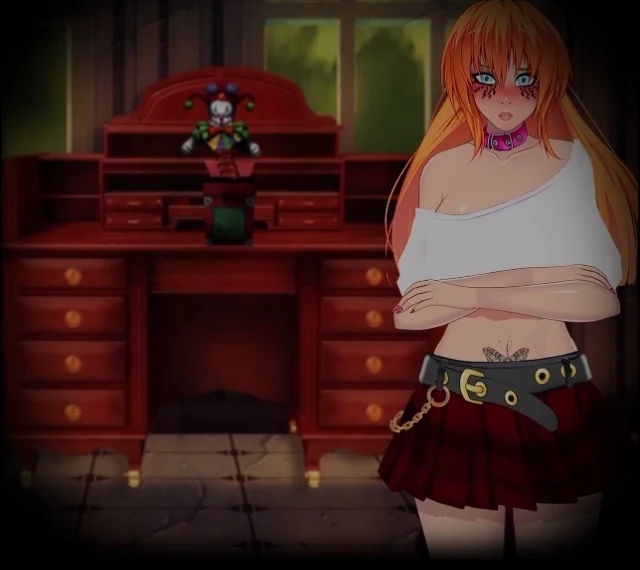
The Bogeyman in the Box — The Jester
One day, a woman came to Agnet and asked her to save a child who was tormented by nightmares every night.
In the girl’s room, Agnet immediately noticed a box containing an unusual creature. She agreed to free the child from her nightmares in exchange for the object itself.
The woman willingly handed over the box.
Agnet took it to her home, opened it in the attic, and came face to face with what she called the Scarecrow.
The creature intended to instill fear.
Agnet simply looked at it.
She didn’t scream.
She didn’t look away.
She didn’t try to close the box.
The bogeyman vanished.
But this wasn’t just a random childhood nightmare.
It was the Jester, manifesting through the box connected to him.
Agnet knew nothing about the living clown of 1585.
She didn’t know about the execution.
She didn’t know about the mask or the Nightmare Merchant.
She didn’t know about Benjamin.
She didn’t realize that standing before her was an entity capable of creating separate worlds, shattering human personalities, and turning fear into the foundation of its own theater.
She forced the Jester to retreat, without even realizing who she had defeated.
In her diary, this episode seems almost mundane: all she had to do was show that she wasn’t afraid, and the Scarecrow vanished.
A Technological Ghost — A Guest from the Black-and-White World
Technology-born ghosts held a special interest for Agnet.
They were not described in ancient grimoires because they emerged alongside new forms of human fear: screens, television, recordings, severe stress, and images separated from the living body.
One day, something from the realm of human nightmares caught Agnet’s attention on the TV.
A creature was trying to crawl out of the screen and move around the house. Theoretically, Agnet could have burned the TV and destroyed the point of manifestation.
But she became curious.
She moved closer and discovered that the visitor was not only dangerous but also, in its own way, attractive—almost like a wild kitten living inside an incomprehensible space.
Agnet kept the TV in her room, noting that the creature could only manifest when the screen was on.
Later, it becomes clear that this was not just some kind of television demon.
A manifestation of the Black-and-White World that had emerged from Johan Weber’s device came into contact with the screen.
Agnet knew nothing of the guard who had lost his face.
She didn’t know how the projection had learned to abduct people.
She didn’t know that its inhabitants had endured their own torments and become beings with distorted logic.
But she discovered the rule governing the manifestation and kept the creature confined within its host.
Even an independent, predatory world was unable to immediately take over her home.
Shogot
Agnet also encountered Shogot—a spatial entity associated with doors, passageways, and errors between worlds.
She did not know its origin or its connection to Za’ha’dum.
She did not understand that, for Shogot, doors are not separate objects and that the human concept of direction means almost nothing to it.
Shogot cannot be controlled by ordinary commands.
It does not serve a master and does not perceive the boundaries of a domain the way a human does.
However, Agnet was able to discern some of its rules and coexist with it, preventing the entity from completely turning the estate into a chaotic tangle of identical doors.
It is likely that her experience interacting with Shogot helped her better understand the nature of portals and later create her own stable ones.
She did not tame him in the usual sense.
But she turned out to be one of the few people in whose presence it was unable to completely destroy the order of space.
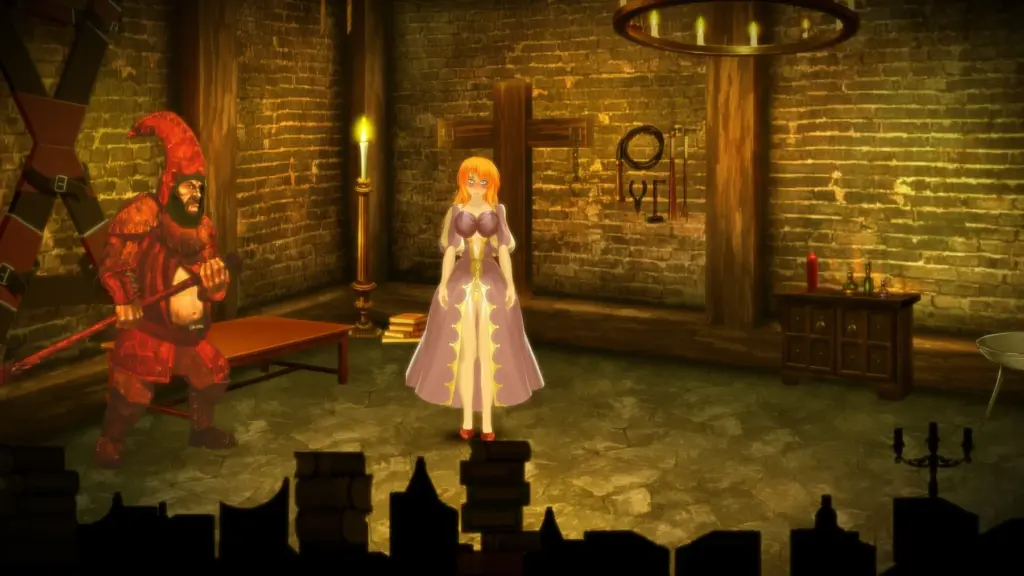
The Inquisitor — Henri Sanson
Agnet called the most dangerous spirit of the estate the Inquisitor.
She didn’t know his real name.
She did not know that before her stood Henri Sanson—the executioner of 1585, the Jester’s tormentor, Maria’s persecutor, and the murderer of Jack the man.
To Agnet, he was an unknown infernal entity that invaded her system, hunted spirits, and grew particularly powerful during the hour of the wolf.
Even ordinary ghosts feared him.
He didn’t want to be part of the collection.
He did not accept the fulfillment of desire as the basis of a contract.
He wasn’t looking for a place in the house.
He wanted to turn the estate itself into a new dungeon.
Agnet managed to banish him and temporarily contain him, though the confrontation drained her of much of her strength.
She couldn’t destroy Henri completely because she didn’t know
who he had been in life;
what deal he had made;
why he was connected to her family;
why he hated the witches of this family;
why Jack, of all people, was the one capable of delivering the final blow.
But even without this information, Agnet held off the Inquisitor long enough to prepare a warning for Chelsea.
She didn’t defeat Henri completely.
She didn’t let him defeat her.
Jack
Agnet didn’t know Jack’s full story.
To her, he was a scarecrow come to life, the Candle Demon, the Desecrator, and the Guardian.
One day, she simply walked past the scarecrow, after which it followed her all the way home. The next night, Agnet returned to the garden and waited for him to wake up.
She didn’t have to issue a difficult challenge.
Jack chose to follow her of his own accord.
The reason became clear much later.
In 1585, Chelsea asked Maria to keep Jack close to their family. Maria granted the request, and even centuries later, a connection to the family’s blood remained within him.
Agnet believed she had found an extraordinary, devoted spirit.
In fact, Jack recognized a descendant of Maria.
She didn’t know his human history, but she accepted him and gave him a place near the house.
Thus, the old promise continued to hold, even though none of those involved fully understood it anymore.
The Infernal Collection
Agnet’s estate was not a cursed house by chance.
She deliberately turned it into a collection, a laboratory, and a system for housing supernatural beings.
Most of the inhabitants had been found, summoned, rescued, captured, purchased along with objects, or redirected from other places.
Agnet tried to find a suitable:
a territory;
a vessel;
a food source;
a way to satisfy their desires;
a limitation;
a condition under which it became relatively safe.
She didn’t just lock up monsters.
She created a suitable environment for them.
The Kind Uncle
The creature, whose secret name was Insatiability, came of its own accord.
Driven by a desire to possess everything, it tried to enter the room. Agnet did not drive it away.
She showed that she wasn’t afraid, allowed it to have what it wanted, and thereby deprived it of its main advantage.
Later, Agnet even hunted frightened passersby alongside it, finding the whole situation amusing.
Then she left the creature in locked rooms, where it could exist without destroying the rest of the house.
This incident shows that Agnet did not merely defend herself against dark beings.
Sometimes she accepted their rules and happily joined in the game.
The Marquis
The Marquis was summoned by Agnet after reading *The Philosophy of Vice*.
She deliberately entered the magic circle to face a creature that was supposed to be a threat, and emerged from the ritual as its mistress.
The Marquis demonstrates just how closely intellectual curiosity, erotic desire, and power are intertwined in Agnet’s magic.
She didn’t just read about vice.
She wanted to see if she herself could go through it and remain free.
The Whirlwind
The Whirlwind, a hellish storm petrel, was summoned by Agnet from the realm of timelessness to destroy her enemies.
It was a mindless yet incredibly powerful creature woven from the threads of chaos. It could destroy not only a human but also a spirit.
The Whirlwind’s heart was kept in a box and served as the control key.
As long as the box remained with Agnet, the creature obeyed her will.
Once, during a chase, the Whirlwind raged so fiercely that the witch had to calm it down herself.
Later, she left it in the garden: the house was too cramped for the creature, and during the hunt, Agnet preferred not to go outside for a while.
Even here, her control was not absolute.
She had not stripped Whirlwind of its nature.
She had learned to take it into account.
The Spirit of the Gramophone
Agnet acquired one creature along with an old gramophone.
It loved music, swayed back and forth, and waited for people to be frightened.
Agnet moved closer.
When the creature realized she wasn’t afraid, it vanished.
The witch noticed that the spirit only became dangerous when the music stopped. So she left the gramophone in the basement and didn’t turn it off unless necessary.
For anyone else, this would have been a curse.
For Agnet, it was just another rule she understood.
A Lost Soul
One spirit wandered through the garden for a long time, not understanding what had happened to it.
It attacked young women who decided to look behind them.
Agnet watched it for a while, then led it to the table and helped it remember who it had been in life.
After regaining part of its memory, the spirit became less dangerous—at least to Agnet herself.
She also gave him an extra incentive to remain loyal.
The witch didn’t just suppress his spirit.
She restored enough of his personality to make it possible to negotiate with him.
The Dead Killer
One of Agnet’s acquaintances set the soul of a long-dead maniac against her.
He had been insane even in life, and upon his return, he wanted to assault the witch before killing her.
Agnet could have summoned Jack or the Whirlwind.
Instead, she decided to see what would happen if she gave the dead man what he wanted.
After that, the spirit returned to the woman who had summoned him and carried out all the dirty work against her instead.
Agnet didn’t just fend off the attack.
She turned the enemy’s weapon into her own messenger.
The Scout Spirit
For one of her rituals, Agnet needed a spying spirit.
She placed it inside an old garden figurine.
The first gnome couldn’t handle it and crumbled, so the witch repeated the process with another vessel. After bringing it to life, she bound the creature with a spell of desire and left it in the garden.
Not even failure could stop her.
If a vessel turned out to be unsuitable, Agnet didn’t give up on her plan.
She simply moved on to the next one.
The Woman in the Mirror
During her lifetime, this woman tormented hundreds of peasants. After her execution, her soul refused to depart and became trapped in the mirror, clinging to it with all the malice she had accumulated.
After her death, the string of crimes continued: young women who happened to glance at their reflection became her victims.
Agnet drew a staircase for the spirit to the human world, established contact with it, and hung the mirror on the wall, waiting for the right moment.
She did not consider destruction to be the only correct response.
Even a cruel soul can be put to good use if one understands its nature and establishes clear boundaries.
Agnet’s True Power
Agnet didn’t know that the Scarecrow was the Jester.
She didn’t know that the TV guest had come from the Black-and-White World.
She did not understand Shogot’s true nature.
She didn’t know the Inquisitor’s human name.
She didn’t know why Jack had followed her specifically.
And yet she managed to:
force the Jester to retreat;
contain the manifestation of the Black-and-White World inside the TV;
coexist with the spatial entity;
banish Henri;
accept Jack and keep him close to her family;
unite a multitude of dangerous creatures into a relatively stable system.
This is precisely what sets Agnet apart from most mages and researchers.
Weber needs a mechanism.
Henri needs fear and official authority.
The Nightmare Merchant needs bargains, artifacts, and suitable vessels.
Agnet enters the creature herself.
She doesn’t always know what lies before her.
But she almost always knows how to deal with it.
Morality and Limits
Agnet is able to help people.
She saved a child from nightmares.
She kept dangerous creatures at bay.
She left warnings for Chelsea.
She tried to free her niece from the Jester’s world.
She preserved her family’s witchcraft.
But she cannot be called a “good witch” in the conventional sense.
She could hunt frightened people alongside Insatiability.
She sent a dead murderer back to her own friend.
She kept dangerous spirits out of curiosity.
She considered physical and psychological risks an acceptable part of the experiment.
She sent Chelsea home without telling her the whole truth.
Agnet isn’t guided by traditional morality.
She’s interested in other questions:
Was there a choice?
Did the person understand the rule?
Did they surrender to fear?
Did they accept the price?
Could they remain true to themselves in the face of desire?
Her cruelty is different from Henri’s sadism.
Henri wants to humiliate and break his victim.
Agnet wants to see what a person becomes when faced with true fear or true desire.
But for someone who hasn’t survived her ordeal, the difference may prove insignificant.
The Estate
Not a Haunted House
Agnet’s estate often looks like a place where demons and ghosts have gathered by chance.
In reality, it was a carefully organized ecosystem.
Each creature had:
a territory;
an anchor object;
a condition for appearing;
a way to calm down;
a rule for expulsion;
the specific form of desire.
As long as Agnet was in the house, the system remained stable.
After her disappearance, it became clear just how much depended on her personally.
The wards began to weaken.
The spirits began to change their behavior.
The Inquisitor began to return.
Objects began opening passages without permission.
Agnet had created a system capable of functioning as long as its mistress was nearby.
But she hadn’t managed to make it fully autonomous yet.
The Hour of the Wolf
The Hour of the Wolf was particularly dangerous.
At that moment, the boundaries between worlds grew thin, and the restrictions Agnet had imposed were temporarily lifted.
Tamed creatures could begin hunting again.
The Inquisitor would emerge from his abode.
Even the relatively harmless spirits stopped honoring their previous agreements.
Agnet warned Chelsea: if she decided not to be kind to the spirits, she’d better not be near them during the hour of the wolf.
She also named the Inquisitor as the only creature the heiress truly had reason to fear.
The Portal Maker
Agnet’s influence extended far beyond the confines of the house.
She learned to create stable passages between worlds and transformed the estate into one of the main hubs of the supernatural network.
Her activities were one of the factors that awakened the Moonlit World.
Before the new passages appeared, many dead gods and frozen beings existed there almost motionless, as if in a fog.
Agnet opened the first paths.
Later, Chelsea and Melissa began to fuel this system even more.
Therefore, the estate cannot be considered merely a haunted house.
It is a device created by a witch without mechanisms:
a laboratory;
a collection;
a refuge;
a trap;
a portal;
a power source for other worlds.
Agnet opened the doors.
Other beings gradually learned to use them without her permission.
The Will
A Deferred Inheritance
Before she disappeared, Agnet drew up an unusual will.
Chelsea had to reach the age of majority, arrive at the estate on October 31, spend the night there completely alone, and not bring a phone, tablet, or other personal devices with her.
At six o’clock in the morning, the condition was considered fulfilled.
After that, Chelsea would receive:
the estate;
access to bank accounts totaling approximately ten million dollars;
magical knowledge;
the opportunity to become the new mistress of the infernal collection;
a witch’s gift.
Agnet knew that a simple request wouldn't convince her niece to spend the night in an abandoned house, so she used money as a lure.
She openly admits that she wouldn’t have been able to get Chelsea to come otherwise.
An Inheritance as a Rite of Passage
The true value of the bequest lay not in the real estate.
Agnet had hidden a spell beyond the material world and divided it among the spirits.
To piece together the formula, Chelsea had to meet the house’s inhabitants, understand their desires, and decide how to deal with them.
The witch advised her not to be afraid and to be kind. In return, the spirits might reveal parts of the spell.
Thus, Chelsea was to become not merely the legal owner of the estate, but the new mistress of the collection.
This is a modern form of an ancient family initiation.
The woman in white came to see Agnet in person.
Agnet turned the entire house into a mentor.
Each room offered a lesson.
Each spirit tested a specific aspect of her character.
Every choice revealed what kind of witch Chelsea would become.
The Right to Refuse
Despite manipulating the inheritance, Agnet leaves the choice up to Chelsea.
She can choose not to go beyond the gate.
She can refuse the collection.
She can banish the spirits.
She can try to tame them.
She can choose the path of pleasure.
She might not become the kind of witch that Agnet was at all.
This is an important distinction between Agnet and Duke Weber or Henri.
She creates dangerous conditions and doesn’t reveal all the information, but she acknowledges the heiress’s right to say “no.”
The only problem is that Chelsea doesn’t know the true extent of the consequences.
A choice exists.
But she doesn’t fully understand the cost.
Why Chelsea?
It’s not exactly clear why Agnet chose Chelsea as her first heiress rather than Melissa.
Perhaps Chelsea was the older one.
Perhaps her gift was more pronounced.
Perhaps Agnet saw her own traits in her: curiosity, sensuality, a tendency to go where she shouldn’t, and the ability to remain true to herself in the presence of the monstrous.
But she was not mistaken about her niece’s potential.
Chelsea managed to:
survive the night at the manor;
interact with the spirits;
make her way through the Dollhouse;
escape from the Jester’s Hell;
return to the year 1585;
meet Maria;
help restore the clan’s knowledge;
close the time loop;
learn how to open and close the portals.
Agnet didn’t just leave her legacy to the right person.
She prepared a woman capable of continuing the work at a significantly higher level.
Jack and Agnet
Agnet put Jack’s abilities to practical use.
He was a guardian, a warrior, and a being capable of performing tasks beyond the reach of an ordinary person.
However, she did not treat him as a disposable tool.
She didn’t know his full story, but she saw him as an individual in his own right.
Later, Agnet:
recognizes the magnitude of his journey;
empowers him;
entrusts him with Chelsea’s rescue;
tries to release him from his promise to Charon;
calls him the finest guardian;
is ready to continue the journey with him;
accepts Lilith’s presence, though she remains wary of her.
Her attitude toward Jack is not particularly tender or romantic.
Agnet rarely expresses affection directly.
But for her, entrusting her own fate and that of her lineage to another being is one of the highest forms of respect.
Disappearance
As far as the human world is concerned, Agnet disappeared about a year before the first story began.
Chelsea believed her to be dead.
But the witch’s soul had not left the world for good.
Agnet found herself in the Interworld—a space crisscrossed by fissures leading to other realities. Creatures from Hell, the Moonlit World, the human world, and countless other reflections can fall into it.
In the Interworld, Agnet existed as a ghost.
She could not return on her own.
To be fully freed, she needed her own blood and four obelisk keys.
A Safe World of Dreams
Agnet did not wander the Interworld without protection.
She was in a relatively safe area—her own world of dreams, surrounded by reflections of hell.
This zone had become both a refuge and a prison.
As long as Agnet remained inside, Baphomet couldn’t simply take her away.
But if she were to step outside, he would immediately have the chance to capture the witch.
That’s why Agnet didn’t leave her safe haven.
Not out of cowardice.
Not out of helplessness.
She had correctly assessed her opponent.
Agnet understood that one wrong move would give Baphomet exactly what he wanted.
So she acted through Jack: she summoned him, explained the task, empowered and guided him, while remaining in a safe zone.
It was the disciplined defense of an experienced witch.
Why Baphomet Wanted Agnet
Baphomet showed a particular interest in her.
The reason lay not only in Agnet’s beauty or erotic power, although her sensuality, vitality, and mastery over desire undoubtedly made her a particularly attractive target.
Agnet possessed a rare ability:
she could subdue creatures she did not understand.
To Baphomet, such a witch was at once:
a coveted captive;
a source of power;
a key to the human world;
the mistress of the network of portals;
a potential guide;
a threat to his power;
proof that humans are capable of subjugating infernal beings without worshiping them.
Baphomet didn’t just need another witch.
He needed a woman who could walk into a room with an unknown monster and walk out in control of the situation.
Jack’s Temptation
Unable to get Agnet directly, Baphomet tried to force Jack to betray her.
He claimed that witches used the Candle Demon:
Agnet kept him in the garden like a scarecrow.
Chelsea made him do other people’s work.
No one was going to restore his human form.
In exchange for the Arcana, Baphomet promised to return Jack to the human world and make him human again.
The offer was very carefully crafted.
Jack did indeed still harbor a desire to regain his former body.
But Baphomet was deceiving him.
He needed the Arcana to destroy Agnet’s defenses, open a path to her world of dreams, and capture the witch.
The promised humanity was a decoy.
Had Jack accepted, the bargain would have become the opposite of the salvation he was promised. Baphomet’s true aim was to obtain the Arcana; refusing him meant that Jack would eventually have to find and destroy him to claim the final card.
Jack refused.
He chose to save Chelsea and Agnet over his own body.
The Nine Arcana
To open a path to the Jester’s hellish universe, Agnet needed the nine Arcana.
They were scattered across various distortions of the Interworld and linked to creatures, trials, and pacts.
Agnet herself could not gather them without leaving the safe World of Dreams.
So she summoned Jack.
The Arcana were no ordinary keys.
To obtain them, Jack had to:
fight;
free captive souls;
reject deals;
make pacts;
explore the reflections of worlds;
pass through Za’ha’dum;
oppose Baphomet.
This continued the philosophy of Agnet.
Power must not lie on the table as a ready-made object.
To obtain it, one must understand the world to which it is bound.
Chelsea’s Rescue and Agnet’s Liberation
Agnet’s plan was not a devious deal.
She had no intention of using Chelsea as a disposable key to her own freedom.
The situation was logical and mutually beneficial.
Chelsea was held captive in the Jester’s hellish universe.
Agnet was locked away in a secure area of the Interworld.
Jack could gather the Arcana and open a path to his niece.
Once rescued, Chelsea—who shared her bloodline—could help Agnet herself escape her confinement.
As a result, everyone won:
Chelsea was freed from the Jester;
Agnet would return from the Interworld;
Jack would fulfill an old duty to his clan;
Baphomet lost his coveted captive;
the family was reunited;
Jester’s path was losing its stability.
Agnet summoned Jack first and foremost because she wanted to save Chelsea.
Her own liberation was the natural next step.
She was saving her niece.
Her niece could save her.
This isn’t manipulation.
This is a family, separated by several worlds, that has finally been given the chance to help one another.
Two outcomes remain possible: Jack can gather the Arcana and open a path to Chelsea, while finding the obelisk keys also allows him to free Agnet.
A Captive, Not a Victim
Even while trapped in the Interworld, Agnet continued to act as an organizer.
She:
maintained a secure zone;
monitored Jack’s movements;
understood the nature of the local distortions;
knew the role of Za’ha’dum;
strengthened her guardian;
noticed captive souls;
gathered knowledge;
prepared the way to Chelsea;
sought a way to return;
resisted Baphomet.
Agnet could have been a prisoner of space.
But she never accepted the role of a helpless woman waiting for someone else to make a decision.
Even from prison, she continued to devise a plan.
Agnet’s Mistakes
Agnet is extremely strong, but she is not infallible.
She Overestimated the Estate’s Stability
As long as the witch was in the house, her collection remained in order.
After she disappeared, it became clear that too much depended on her personal authority.
She hadn’t managed to create a fully autonomous system.
She Underestimated Henri
Agnet was able to banish the Inquisitor, but she did not uncover his true history or destroy him completely.
She left Chelsea a warning, but the most dangerous spirit continued to exist.
She Entrusted Her Will to Duke Weber
The Duke gained access to the documents, the inheritance, and the estate.
Later, he attempted to seize the collection and turn the house into his own stronghold.
Agnet managed to understand the demons, but the human legal system proved to be a vulnerability.
She Considered Desire to Be an Almost Universal Key
Her method worked with many beings.
But not every entity can be made safe by satisfying its nature.
And not every person is capable of undergoing such an interaction without serious consequences.
Curiosity Often Outweighs Caution
Agnet keeps the dangerous creature because it’s interesting.
She doesn’t destroy the TV.
She leaves the mirror.
She takes the box.
She steps inside the circle.
She explores the portal.
This trait made her a great witch.
It was probably this same trait that once led Agnet to the Interworld.
Agnet and Chelsea
Agnet and Chelsea are more alike than they seem.
Both:
don’t like to follow other people’s rules;
go where they’re warned not to go;
see fear as an obstacle;
use their desires to communicate with entities;
are capable of negotiating with monsters;
attract the attention of other worlds;
do not consider physical pleasure to be shameful;
can transform their own sensuality into a source of power.
But there is an important difference between them.
Agnet has already developed a philosophy and has almost no doubts about it.
Chelsea continues to make choices.
She can tame a spirit, banish it, help it, deceive it, subdue it, or walk away.
Agnet wanted to pass on her own path to her.
But Chelsea is capable of not only continuing her aunt’s legacy but also correcting her mistakes.
Agnet and Maria
Maria is a distant ancestor of Agnet, but their connection goes far beyond ordinary kinship.
Both have experienced a break in the transmission of the gift.
Maria received only a portion of the knowledge.
Agnet was completely unaware of the existence of the family tradition.
Chelsea helped both of them—but in opposite directions in time.
Agnet passed the gift on to Chelsea.
Chelsea traveled back in time and helped Maria.
Maria kept Jack close to the family.
Centuries later, Jack found Agnet.
Each of the three women saved a part of the legacy that did not yet exist in her own time.
Agnet and Melissa
Melissa wasn’t the first heiress, but she still found herself caught up in the consequences of Agnet’s work.
After Chelsea’s disappearance, she continued the search, entered the Jester’s Theater-Museum, and made her way to the estate.
Later, the sisters restored the house as their aunt had wished and began searching for Agnet herself.
While Chelsea inherits the psychic ability to interact directly with spirits, Melissa more often tries to understand the rules, explore the space, and find a safe way out.
Agnet chose one primary heir.
But her work ultimately awakened both sisters.
Abilities
Hereditary Gift
Agnet can sense the presence of spirits, magical objects, and the boundaries of other worlds.
Summoning Entities
She is capable of summoning creatures from hell, the void, and other realms.
Taming Through Desire
Agnet establishes a connection with an entity by satisfying, redirecting, or accepting its primary need.
Erotic Magic
She uses physical intimacy, arousal, and pleasure as a form of contact, power exchange, and establishing control.
Subjugation Through the True Name
The witch understands the significance of secret names and is able to use them as a foundation for power.
Creating Anchors
The Heart of the Vortex, a mirror, a box, a television, a gramophone, and other objects become vessels or containment devices for entities.
Opening Portals
Agnet creates stable passages and transforms the estate into an interworld hub.
Dream Magic
She interacts with entities through dreams and is capable of creating a protected space within her own consciousness in the Interworld.
Hiding Beyond the Material World
Agnet has hidden parts of the spell so that an ordinary person cannot simply find or steal them.
Control Spells
She restricts the activity of spirits, binding them to objects, places, and specific conditions.
Working with Souls
Agnet sees captive souls, understands how to free them, and uses ancestral blood as the basis for returning from the Interworld.
Preserving Youth
Her connection to spirits and other realms allows her to significantly slow the normal aging process.
Limitations
Her Power Is Personal
Many spirits obey not an abstract seal, but Agnet herself.
After her disappearance, the system weakens.
Spells Lose Their Power During the Hour of the Wolf
When the boundaries thin, spirits are able to break free from their constraints.
Not Every Entity Can Be Tamed
Henri proved too dangerous to be fully controlled.
Baphomet was also beyond the reach of her usual methods.
She Is Bound by the Rules of Blood
Even a powerful witch cannot leave the Interworld on her own. To return, she needs a blood bond.
Curiosity Makes Her Vulnerable
Agnet often spares a threat rather than destroying it.
Desire Does Not Always Mean Consent
Her method is based on revealing hidden desires, but a person may experience pleasure and still not want to become part of someone else’s system.
Chelsea understands this boundary better.
Connections and Meaning
Agnet embodies power over the monstrous by accepting its nature.
Henri declares desire a sin and destroys people for it.
The Webers turn the supernatural into a mechanism.
The Jester turns others’ desires into a spectacle.
Gretta turns them into her property.
Agnet creates a collection.
But her collection isn’t made up of dead exhibits.
The spirits continue to live, desire, hunt, argue, and sometimes get out of control.
She does not destroy their nature.
She incorporates it into the system.
The estate is a reflection of Agnet herself:
beautiful;
sensual;
dangerous;
full of locked rooms;
capable of harboring a monster;
confident that there is a suitable place for any horror.